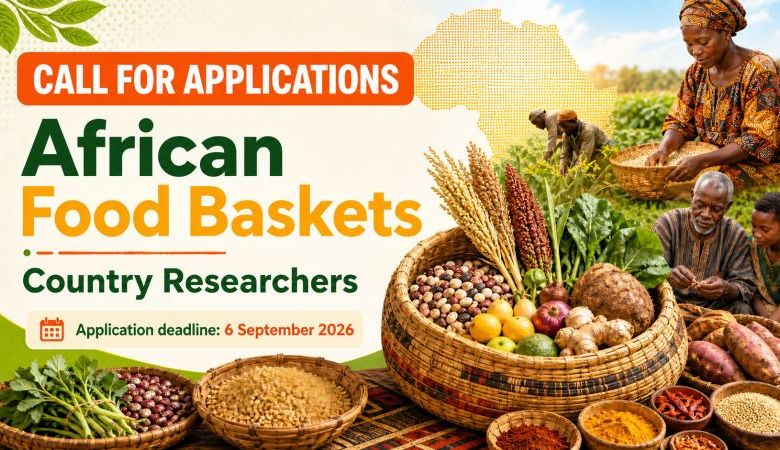
The Alliance for Food Sovereignty in Africa (AFSA) has opened a Call for Applications for African Food Baskets Country Researchers, inviting qualified researchers from across Africa to contribute to an important initiative focused on documenting, preserving and promoting the continent’s rich food heritage.
The initiative will select 10 Country Researchers, with one researcher representing each participating country. Selected researchers will work with communities and local knowledge holders to document traditional and contemporary food knowledge, including foods, dishes, beverages, recipes, menus, food sources, stories, proverbs and other forms of cultural knowledge connected to food.
The assignment provides an opportunity for African researchers with relevant experience in research, community engagement, documentation and data collection to contribute to a continental resource that will support advocacy, education, research, communication and policy engagement.
About the African Food Baskets Initiative
The African Food Baskets initiative is being implemented by the Alliance for Food Sovereignty in Africa (AFSA) as part of the TAFS Project, with funding from Sida.
The initiative also contributes to AFSA’s #MyFoodIsAfrican campaign, which seeks to celebrate African food systems and strengthen recognition of the knowledge, practices and cultural traditions that underpin food sovereignty across the continent.
Food is an important part of Africa’s cultural identity. Traditional foods, preparation methods, recipes, farming practices and community knowledge have been passed from generation to generation. However, much of this knowledge remains undocumented and can be vulnerable to loss as food systems and lifestyles change.
The African Food Baskets initiative aims to help address this gap by systematically documenting food heritage across participating African countries.
The first phase will focus on 10 countries, selected with the objective of achieving regional balance and ensuring representation across Anglophone, Francophone and Lusophone Africa. The final participating countries will be determined following the application and selection process.
What Will Country Researchers Do?
Selected researchers will be responsible for documenting the food heritage of their assigned country using the African Food Baskets KoboToolbox Toolkit.
The work will involve engaging directly with communities and people who possess local and traditional food knowledge.
Key activities are expected to include:
- Identifying and documenting foods that form part of the country’s food basket.
- Recording traditional and contemporary dishes and beverages.
- Documenting recipes and food preparation practices.
- Identifying food sources and traditional food systems.
- Collecting menus and other relevant food-related information.
- Recording stories, proverbs and cultural knowledge associated with food.
- Engaging communities and local knowledge holders.
- Conducting field-based data collection.
- Taking photographs to support the documentation.
- Validating collected information with relevant communities and knowledge holders.
- Using the designated KoboToolbox toolkit to capture information.
- Preparing and submitting a complete country data package.
- Producing a brief narrative report highlighting key findings.
Researchers will therefore combine research, community engagement, fieldwork, documentation and digital data collection throughout the assignment.
Who Can Apply?
The opportunity is aimed at qualified African researchers with the ability to undertake research and community-based documentation within an African country.
Candidates should have relevant experience that enables them to engage communities, collect reliable information, document cultural knowledge and present research findings effectively.
Experience in areas such as the following may be particularly relevant:
- Social research
- Food systems research
- Agriculture
- Food sovereignty
- Anthropology
- Sociology
- Cultural studies
- Community development
- Indigenous knowledge
- Qualitative research
- Field research
- Documentation and storytelling
- Data collection
- Participatory research
Strong community engagement and communication skills will also be valuable because the assignment requires researchers to work with local knowledge holders and communities.
Applicants should consult the full Terms of Reference for the specific eligibility requirements and selection criteria.
Research and Community Engagement
A key feature of this opportunity is its emphasis on working with communities rather than simply collecting information from secondary sources.
Country Researchers will be expected to identify relevant local knowledge holders and engage them in the documentation process. This may involve collecting information about traditional foods, recipes, food preparation methods, cultural practices and stories that are important to communities.
The validation stage will also be important. Researchers will need to ensure that information collected during the fieldwork is reviewed and validated before the final country data package is submitted.
This approach is intended to help create a resource that accurately reflects Africa’s diverse food traditions and the communities that sustain them.
A Continental Resource for African Food Knowledge
The information gathered through the African Food Baskets initiative is expected to contribute to a broader continental resource on African food heritage.
The resource will have potential applications in several areas, including:
Advocacy: Supporting efforts to promote food sovereignty and stronger African food systems.
Research: Providing information that can support researchers studying food, agriculture, culture and development.
Education: Helping preserve and share knowledge about African foods and food traditions.
Communication: Creating opportunities to tell African food stories and highlight the continent’s diverse food heritage.
Policy engagement: Supporting conversations around food systems, food sovereignty and related policy issues.
By documenting local knowledge at country level, the initiative seeks to build a stronger understanding of the food traditions and knowledge systems that exist across Africa.
Language of Application
Applications may be submitted in English, French or Portuguese, making the opportunity accessible to researchers working across Africa’s diverse linguistic contexts.
Applicants should ensure that their submissions follow the requirements outlined in the full Terms of Reference.
How to Apply
Qualified researchers interested in participating in the African Food Baskets initiative should prepare their application in accordance with the requirements provided in the official TOR.
Applications should be submitted by email to:
Application deadline: 6 September 2026
Applicants are strongly encouraged to review the complete Terms of Reference before submitting their applications. The TOR contains important information about the scope of work, eligibility criteria, deliverables, assignment timeline, selection process and required application documents.
Key Opportunity Details
- Opportunity: African Food Baskets Country Researchers
- Organisation: Alliance for Food Sovereignty in Africa (AFSA)
- Number of researchers: 10
- Coverage: African countries
- Project: TAFS Project
- Funding: Sida
- Focus: African food heritage, food knowledge and food sovereignty
- Research method: Community engagement and field data collection
- Data platform: KoboToolbox
- Application languages: English, French or Portuguese
- Application deadline: 6 September 2026
- Application email: [email protected]
Why This Opportunity Matters
The African Food Baskets initiative offers researchers an opportunity to contribute to the preservation of knowledge that is deeply connected to African communities, cultures and food systems.
For researchers interested in food sovereignty, agriculture, culture, indigenous knowledge, community development, social research or African food systems, the assignment provides an opportunity to apply research skills to a project with continental relevance.
The initiative also places local communities and knowledge holders at the centre of the documentation process, helping ensure that African food heritage is recorded and promoted as a valuable source of knowledge for future generations.
Researchers who meet the requirements are encouraged to review the full TOR and submit their applications before the 6 September 2026 deadline.