Apply for the Royal Society Short Industry Fellowship 2026
Could a 3–6 month funded research secondment help scientists build industry connections, advance their careers and turn academic research into real-world innovation?
The Royal Society Short Industry Fellowship 2026 is now open, offering talented researchers in UK academia and industry an opportunity to undertake dynamic, collaborative projects across the two sectors.
With applications open until 7 October 2026, the scheme supports researchers who want to strengthen links between universities, research organisations and private industry while developing their scientific and professional experience.
Funded by the UK Department for Science, Innovation and Technology (DSIT), the fellowship is particularly encouraging applications from early-career researchers and collaborations involving early-stage companies.
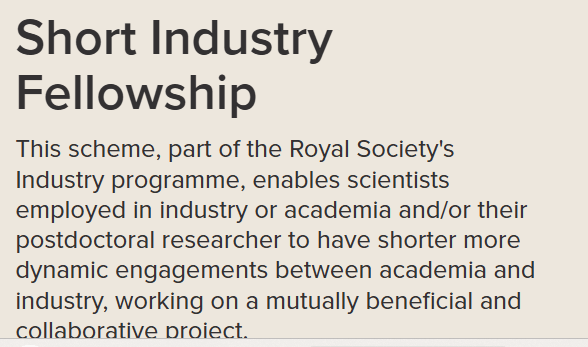
The Short Industry Fellowship is part of the Royal Society’s Industry programme and is designed to facilitate short-term mobility between academia and industry.
The scheme enables a scientist employed in academia or industry, and/or their postdoctoral researcher, to work collaboratively with an organisation in the other sector.
Rather than supporting a purely academic research project, the fellowship is structured around a mutually beneficial collaborative project involving mobility between a UK-based private industry organisation and a UK university or not-for-profit research organisation.
This makes the opportunity particularly relevant to researchers interested in understanding how scientific knowledge can be transferred between research institutions and industry.
Apply for the Royal Society Short Industry Fellowship 2026: What Does the Fellowship Fund?
The Royal Society provides funding that can support the fellow during the secondment.
Awards can be undertaken:
- Full-time for 3 to 6 months, or
- 50% part-time for up to 12 months
The part-time option provides additional flexibility for researchers who want to maintain stronger links with their employing organisation during the fellowship.
Funding can cover the applicant’s and/or their postdoctoral researcher’s basic salary while on secondment. The employing organisation continues to pay national insurance and pension contributions.
The scheme can also provide research expenses of up to £1,000.
This means the fellowship provides financial support for both the researcher’s time and limited project-related research costs.
Apply for the Royal Society Short Industry Fellowship 2026: Key Benefits of the Short Industry Fellowship
The programme is designed to deliver benefits beyond short-term research funding.
1. Build Academia–Industry Partnerships
One of the central objectives is to establish and strengthen collaborative relationships between academic and industry organisations.
These relationships can potentially develop into longer-term partnerships, joint research projects and future funding opportunities.
2. Develop Your Career
Working in another sector can give researchers valuable experience outside their normal professional environment.
An academic researcher may gain insight into industrial research, commercialisation and applied innovation, while an industry researcher may gain exposure to academic research environments and approaches.
3. Strengthen Knowledge Exchange
The fellowship supports the exchange of scientific and technological knowledge between academia and industry.
This can help move research ideas from laboratories and universities toward practical applications while allowing industry challenges to inform future research.
4. Create Longer-Term Opportunities
The Royal Society anticipates that relationships established through the fellowship can contribute to longer-term collaborations.
For researchers, this could create opportunities to develop partnerships, seek additional funding and expand professional networks.
Who Is the Fellowship For?
The Short Industry Fellowship is open to talented researchers, particularly early-career researchers, working in academia or industry in the UK.
The fellowship operates across the natural sciences and requires mobility between sectors.
Eligible collaborations must involve:
- A UK-based private industry organisation, and
- A UK university or not-for-profit research organisation
The scheme therefore is not simply a general research fellowship. Applicants need to demonstrate a genuine collaboration between the two sectors.
Early-Stage Companies Are Encouraged
The Royal Society particularly encourages collaborations involving academia and early-stage companies.
This is significant for researchers working on innovative technologies or emerging scientific solutions, as smaller companies can provide an environment where research can be closely connected to practical applications.
The programme is intended to help establish personal and corporate links that can support the longer-term development of both researchers and organisations.
Flexible Fellowship Arrangements
The Royal Society recognises that researchers have different professional and personal circumstances.
For this reason, the fellowship provides flexibility around working arrangements, including part-time working, sabbaticals and secondments.
A researcher who cannot take a full-time break from their current organisation may therefore be able to undertake the fellowship at 50% part-time for up to 12 months.
The scheme also includes provisions relating to maternity, paternity, shared parental, adoptive and extended sick leave, as well as financial support for childcare costs that arise from attending conferences and research visits.
What Makes This Opportunity Valuable?
The modern research environment increasingly requires collaboration between universities, companies and other organisations.
Scientific discoveries can have greater impact when researchers understand both the academic and commercial environments in which innovation takes place.
The Short Industry Fellowship addresses this need by creating structured opportunities for researchers to move between sectors.
For an early-career scientist, the experience can provide a valuable opportunity to develop new technical, professional and collaborative skills while gaining a better understanding of how research operates outside their usual environment.
For participating organisations, the fellowship can help establish relationships that may lead to future collaboration and funding.
Important Deadline
The current application round is open, with applications due by:
7 October 2026
Researchers interested in applying should begin discussions with their proposed academic or industry partner well before the deadline.
Because the fellowship requires genuine mobility between academia and industry, applicants should ensure that the proposed collaboration satisfies the scheme’s eligibility requirements before preparing their submission.
How to Apply
Applications are submitted through the Royal Society’s Flexi-Grant platform.
Applicants should carefully review the official scheme notes and eligibility requirements before submitting their application.
The application should demonstrate how the proposed secondment will:
- Support collaboration between academia and industry
- Benefit the fellow’s career development
- Facilitate knowledge exchange
- Contribute to scientific or technological development
- Establish or strengthen links between the participating organisations
- Potentially create opportunities for longer-term collaboration
Researchers should also clearly explain why the proposed mobility between sectors is important to the project.
Final Takeaway
The Royal Society Short Industry Fellowship 2026 provides a valuable opportunity for UK-based researchers seeking to bridge the gap between academic research and industry.
With funding available for the fellow’s basic salary during the secondment and research expenses of up to £1,000, the scheme can provide meaningful support for a short, focused period of collaborative research.
The opportunity is particularly attractive to early-career researchers, scientists interested in applied research and organisations seeking to develop longer-term academia–industry partnerships.
Applications close on 7 October 2026. Researchers interested in participating should review the eligibility requirements, identify an appropriate partner organisation and begin preparing their application through the Royal Society’s Flexi-Grant system.