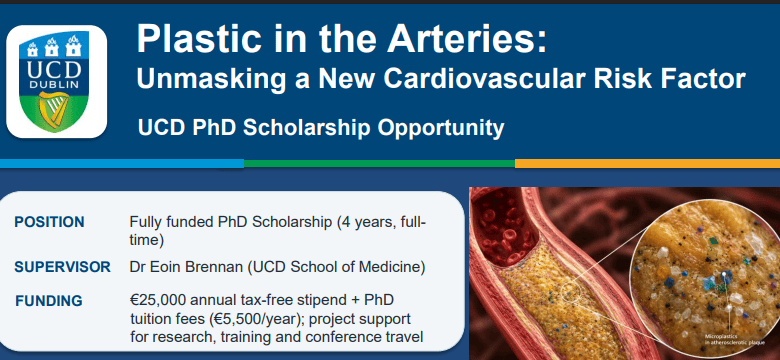
University College Dublin (UCD) is inviting applications for a fully funded four-year PhD opportunity exploring an emerging and potentially significant question at the intersection of cardiovascular biology and environmental health: could micro- and nanoplastics contribute to vascular disease?
The PhD project, titled “Plastic in the Arteries: Unmasking a New Cardiovascular Risk Factor,” will investigate the possible role of plastic particles in the development and progression of cardiovascular disease. Based within the UCD School of Medicine and the UCD Conway Institute, the project offers an interdisciplinary research opportunity for a highly motivated candidate with a background in biomedical science, biological sciences or a related field.
Successful applicants will receive a €25,000 annual tax-free stipend, alongside full PhD tuition fee support, for the four-year, full-time doctoral programme.
The application deadline is 20 September 2026.
Investigating an Emerging Question in Cardiovascular and Environmental Health
Microplastics and nanoplastics have become an increasingly important area of scientific investigation as researchers continue to identify these particles in different parts of the human body.
While concerns about environmental plastic pollution have been widely discussed, scientists are now examining whether exposure to tiny plastic particles could have consequences for human health. Of particular interest is the detection of micro- and nanoplastics in human tissues, including within atherosclerotic plaques.
Atherosclerosis involves the build-up of fatty deposits and other materials within artery walls. These plaques can contribute to serious cardiovascular conditions by narrowing blood vessels or becoming unstable.
However, an important scientific question remains: are micro- and nanoplastics simply present in these plaques, or could they actively contribute to vascular disease?
This fully funded PhD project at UCD will seek to investigate this emerging question through advanced experimental approaches involving human tissues, cellular models and innovative three-dimensional human blood-vessel models.
The research could contribute to a deeper understanding of the relationship between environmental exposures and cardiovascular health while helping to explore whether plastic particles represent a previously underappreciated cardiovascular risk factor.
Research Using Human Carotid Plaques and Advanced Vascular Models
The PhD candidate will work across several complementary research approaches designed to examine how micro- and nanoplastics may interact with the cardiovascular system.
The project will involve research using human carotid plaques, providing an opportunity to investigate plastic particles in the context of human vascular disease.
In addition, the student will use vascular and immune cell models to explore potential biological mechanisms through which micro- and nanoplastics may affect cells involved in vascular health and disease.
The research will also incorporate 3D human blood-vessel models. These advanced experimental systems can help researchers investigate complex biological interactions in a setting designed to provide insights beyond those available through conventional cell culture alone.
By combining human tissue research with cellular and three-dimensional models, the project aims to create a multidisciplinary framework for investigating the potential cardiovascular effects of plastic exposure.
Extensive Training Across Multiple Scientific Disciplines
One of the major features of this PhD opportunity is the broad interdisciplinary training available to the successful candidate.
The student will gain experience in microplastic characterisation, an important area of research as scientists seek reliable methods to identify and study tiny plastic particles in biological and environmental samples.
Training will also cover advanced imaging, enabling the researcher to investigate biological samples and interactions at a detailed level.
The PhD candidate will further develop expertise in molecular and cellular biology, supporting investigations into how vascular and immune cells respond to relevant exposures and biological conditions.
The project will also provide training in transcriptomics and bioinformatics. These areas can enable researchers to study patterns of gene activity and analyse complex biological datasets.
This combination of skills makes the programme particularly attractive for candidates interested in developing expertise across both experimental and computational approaches.
Over the four-year PhD, the successful applicant will have the opportunity to build a multidisciplinary research profile spanning cardiovascular biology, environmental health, molecular science, imaging and data analysis.
Who Should Apply?
The opportunity is aimed at a motivated and enthusiastic candidate with a background in biomedical sciences, biological sciences or a related discipline.
The research is particularly suitable for someone who is interested in interdisciplinary science and excited by questions that connect different areas of research.
Applicants should have a strong interest in exploring the interface between cardiovascular biology and environmental health.
As the project incorporates human tissue research, vascular and immune cell models, microplastic characterisation, imaging, transcriptomics and bioinformatics, the ideal candidate will be eager to learn new methods and work across multiple scientific disciplines.
This PhD may be especially relevant to graduates interested in research careers in areas such as cardiovascular disease, environmental health, toxicology, molecular biology, biomedical research, translational science and related fields.
Funding and PhD Benefits
The successful candidate will receive a comprehensive funding package that includes:
- A 4-year, full-time PhD position
- An annual €25,000 tax-free stipend
- PhD tuition fees covered
- Research based at the UCD School of Medicine
- Opportunities to engage with the UCD Conway Institute
- Interdisciplinary training across laboratory and computational research methods
- Experience working at the intersection of cardiovascular and environmental health research
The funding package provides important financial support for a candidate undertaking a full-time doctoral degree while focusing on developing advanced research expertise.
Study at UCD School of Medicine and the UCD Conway Institute
The project will be based within the UCD School of Medicine / UCD Conway Institute.
The University College Dublin research environment offers the successful candidate an opportunity to undertake doctoral research within an academic setting focused on biomedical discovery and innovation.
The interdisciplinary nature of the project may also provide valuable experience for candidates seeking to address complex health challenges that cannot be understood through a single scientific discipline.
As environmental exposures increasingly become part of discussions around human health, research exploring their potential effects on cardiovascular disease could become an important area of future investigation.
How to Apply
Interested candidates should carefully review the full project description and application information provided in the official PhD opportunity PDF before submitting an application.
Applicants should ensure that they meet the academic and candidate requirements outlined in the full call and prepare any documents requested as part of the application process.
The deadline for applications is 20 September 2026.
Prospective applicants are encouraged to submit their applications before the deadline and pay close attention to the official project requirements.
An Opportunity to Explore a Potential New Cardiovascular Risk Factor
The “Plastic in the Arteries: Unmasking a New Cardiovascular Risk Factor” PhD represents an opportunity to investigate a timely and emerging scientific question.
With funding for four years, a €25,000 annual tax-free stipend, tuition fee support and training across multiple advanced research methods, the programme offers a strong opportunity for an aspiring researcher interested in cardiovascular biology and environmental health.
For a candidate eager to investigate whether micro- and nanoplastics could play an active role in vascular disease, this UCD PhD could provide the platform to contribute to an important and developing area of biomedical research.
Application Deadline: 20 September 2026