
Scholarship deadlines can fall a year before college starts. Scholarship opportunities by deadline vary across merit-based, need-based, group-specific, and annual programs, so there is no single application calendar. Start searching early and prioritize applications with the earliest deadlines.
It is easy to focus on the award amount and overlook timing, but even a strong application will not count if it arrives after the deadline. High school students are advised to research scholarships during the summer between their junior and senior years. Students accepted to college can start searching as soon as they receive an acceptance letter.
This guide compares when different scholarship programs open and close, the eligibility criteria they use, and how award schedules affect planning. You will also find practical ways to organize applications, prioritize deadlines, and identify opportunities that fit your education plans. Consider timing and award details together to build a realistic schedule, rather than relying on one deadline or scholarship type.
Key Takeaways
- Begin searching early: some scholarship deadlines fall a year before college starts, and high school students are advised to research during the summer between junior and senior years.
- Prioritize applications by due date, then organize each program’s eligibility requirements and submission materials in one calendar.
- Compare merit-based and need-based awards by their selection criteria, including academic performance and financial need.
- Look beyond broad eligibility: programs for particular groups may set specific requirements tied to identity, experience, health, or academic interests.
- Check both the application deadline and award schedule; annual programs can offer another opportunity to apply in a later cycle.
1. Scholarship deadlines and application timing
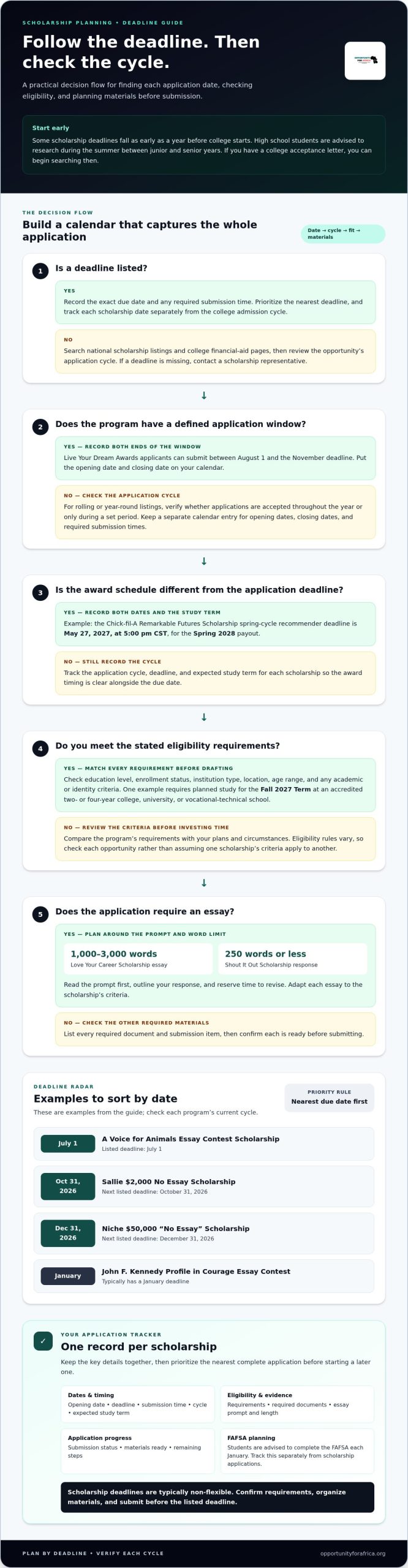
Some scholarship deadlines fall as early as a year before college starts. High school students should research and apply during the summer between junior and senior years. Students can begin searching as soon as a college acceptance letter arrives, then prioritize applications with the earliest deadlines. Scholarship opportunities by deadline may fall before, during, or after an institution’s admission cycle, so track each date separately.
For October 2026, the Sallie $2,000 No Essay Scholarship lists October 31, 2026, as its next deadline. The Niche $50,000 “No Essay” Scholarship lists December 31, 2026, so it offers more preparation time. A Voice for Animals Essay Contest Scholarship has a July 1 deadline, while the John F. Kennedy Profile in Courage Essay Contest typically has a January deadline.
For rolling or year-round deadlines, search national scholarship listings and college financial-aid pages, then review each opportunity’s application cycle. Some programs accept applications during a defined window rather than throughout the year. For example, Live Your Dream Awards applicants can submit between August 1 and the November deadline. Keep a separate calendar entry for opening dates, closing dates, and required submission times.
Fall and spring cycles can also shape when students apply and receive awards. The Chick-fil-A Remarkable Futures Scholarship’s spring-cycle recommender deadline is May 27, 2027, at 5:00 pm CST, for the Spring 2028 payout. That example shows why applicants should distinguish the application deadline from the award schedule. Record the cycle, deadline, and expected study term for each scholarship.
Eligibility requirements determine whether an application is worth preparing. Check the eligible education level, enrollment status, institution type, location, age range, and any academic or identity criteria. One opportunity requires applicants to plan undergraduate or graduate study for the Fall 2027 Term at an accredited two- or four-year college, university, or vocational-technical school. Match every requirement before drafting materials.
Essay-based applications need extra lead time because prompts and word limits differ. The Love Your Career Scholarship requires an essay between 1,000 and 3,000 words, while the Shout It Out Scholarship response must be 250 words or less. Read the prompt first, outline a response, and reserve time to revise. Don’t reuse one essay without adapting it to each scholarship’s criteria.
Build a simple application tracker with the scholarship name, deadline, eligibility, required documents, essay length, and submission status. FAFSA planning belongs on that calendar too: students are advised to complete the FAFSA each January. Scholarship deadlines are typically non-flexible. If a deadline is missing, contact a scholarship representative, and prioritize the nearest complete application before starting a later one.
2. Merit-based and need-based scholarships
Merit-based scholarships recognize achievement, while need-based awards consider a student’s financial circumstances. The categories may use different selection criteria, even when both support study at an accredited institution. Before applying, identify the eligibility rules and what materials demonstrate that you meet them. A high grade-point average may support a merit application, while financial information may be central to a need-based review. One category does not automatically exclude the other.
Academic thresholds vary by program. The Innovation in Education Scholarship requires a minimum GPA of 3.0. Science Buddy Scholarship applicants must have earned at least a 2.5 GPA during their last academic year. These examples show why applicants should compare their own record with each program’s stated requirement, rather than dismissing every merit award based on one scholarship’s standards.
Award amounts also differ. Those figures describe the awards, not the selection criteria: read each program’s eligibility rules to understand what it values. A strong academic record may suit an academic award, but check whether enrollment plans or other conditions also apply.
Need-based opportunities consider financial circumstances as part of the award decision. Prepare accurate financial information and follow the program’s instructions for submitting it. The FAFSA is a separate part of financial-aid planning, and students are advised to complete it each January. Its information can help determine aid eligibility, but scholarship programs set their own application requirements. Track the two processes separately.
Use a short comparison process before drafting applications. First, label each opportunity as merit-based, need-based, or using criteria from both categories. Next, record GPA requirements, financial documentation, eligible degree level, and enrollment conditions. Then match each requirement to evidence you can provide, such as an academic record or requested financial details. For example, a student below a 3.0 GPA can compare the Innovation in Education requirement with Science Buddy’s 2.5 threshold.
Assess the application workload alongside the award conditions. Review the full criteria, confirm that your school and study plans qualify, and submit only when all required materials are ready. Comparing requirements this way helps you focus on awards that fit your record and circumstances.
Compare each opportunity’s requirements, requested evidence, and award conditions, then prioritize applications you can complete accurately. Scholarships are gifts that do not need to be repaid, but review the terms before accepting an award and make sure your application reflects your circumstances. A careful comparison helps you focus on scholarships that fit your academic record or financial situation, rather than choosing by award size alone.
3. Scholarships for particular groups
Scholarships serve students at different education stages, from school seniors to undergraduate and graduate students. The Sara Scholarship targets female college-bound high school seniors with a minimum GPA of 3.3 and some involvement with golf. The Prince Justice Memorial Scholarship accepts eligible high school seniors, graduates, and students enrolled in college, trade school, or graduate school.
Eligibility can combine personal circumstances with education status. The Prince Justice Memorial Scholarship is open to BIPOC students aged 17 and older who have Sickle Cell Disease. Applicants must also meet its school-status criteria, such as graduating from high school or being enrolled in an eligible program. Review each requirement as a separate condition before preparing an application.
Some group-specific programs also set award amounts that help applicants compare opportunities. The Sara Scholarship’s defined academic, gender, and golf criteria make it important to assess every condition, not just the high-school-senior requirement. Match your circumstances to the full eligibility description before investing time in an application.
State, college, and community scholarships can broaden a search beyond national programs. Students can look for awards associated with their state, school, community, employers, nonprofits, religious groups, and professional or social organizations. Search by your location and institution, then compare each opportunity’s eligibility rules.
For a college-specific award, start with the institution’s scholarship and financial-aid information. Community opportunities may be administered by local groups, employers, or other organizations. A school counselor can also help identify awards connected to a student’s community or education plans. Add each promising program to your tracker with its eligibility conditions and application date.
Make a group-focused search more efficient by identifying the criteria that describe you, then pairing them with your current education stage and location. For example, a graduate student can compare their circumstances with the Prince Justice Memorial Scholarship’s age, identity, health, and enrollment requirements. A high school senior involved in golf can review the Sara Scholarship criteria. Apply only if you meet every stated condition.
Record which documents demonstrate your eligibility. A transcript may support an academic requirement, while enrollment information can show your education status. Organize sensitive personal details and submit them only as the application requests. Comparing group criteria with state, college, and community options helps you build a focused list without overlooking relevant opportunities.
4. Annual scholarship programs
Annual scholarship programs can offer recurring chances to apply, but each cycle has its own deadline and eligibility rules. Missing one cycle does not always end the opportunity: students who do not receive a scholarship one year can apply for the same scholarship the following year. Add the next cycle to your future tasks, then check its requirements before applying again.
High school seniors should pay particular attention to senior-year eligibility. Confirm that you meet the program’s criteria before preparing materials, and add the application window and required documents to your calendar as soon as the cycle opens.
Other programs serve distinct study or career paths. The Gates Millennium Scholarship states that it covers the full cost of attendance and has a September 15 deadline. Compare coverage and eligibility, not just the headline amount.
Annual deadlines can fall in different seasons. The PGA WORKS John & Tamara Lundgren Scholars Program has a February 6, 2026 deadline. Since that listed date has passed, treat it as a cycle reference, not a future submission date.
Some cycles connect eligibility to a specific graduating class or professional goal. The National Washington Crossing Foundation scholarship is for students completing twelfth grade or their final high school year in 2027 who plan careers in government service. The Francis E. Moore Prime Time Ministries Scholarship awards $2,000 to two winners every year, and its next deadline is March 15, 2027.
Build an annual tracker with the program name, deadline, award schedule, eligible education level, and renewal or repeat-application rules. Track application dates separately from the period when funds support tuition or other financial needs. A deadline in one academic cycle, for example, may lead to a later payout, so note both dates when the program provides them.
Use past cycles as a planning guide, not as proof that every detail will stay the same. Before applying again, compare the current program’s eligibility rules, required materials, and award conditions with your saved notes. Graduate students should confirm that the program supports graduate study, while high school seniors should check the class-year criteria. This review keeps annual opportunities aligned with current study plans.
5. Scholarship deadlines and award schedules
Compare the award amount with the deadline, eligibility rules, and payment schedule. A high amount does not automatically make an opportunity the best fit for your academic plans or career interests.
Renewal terms depend on the specific award. Read the conditions to understand whether funding is one-time or recurring, and record any study-period requirements alongside the application deadline.
For the current academic year, listed deadlines include October 31, 2026, for the Sallie $2,000 No Essay Scholarship and December 31, 2026, for the Niche $50,000 “No Essay” Scholarship. Later examples include the Emmtacular Scholarship on April 12, 2027, and the Public Service Scholarship of the Law Office of Shane Kadlec on May 1, 2027.
Other upcoming United States examples include the Prince Justice Memorial Scholarship, due May 19, 2027, and the Learner Scholarship for High School Seniors, due May 30, 2027. The Francis E. Moore Prime Time Ministries Scholarship lists March 15, 2027, as its next deadline. Confirm each listed date against the scholarship sponsor’s official application information before planning submission.
Build a month-by-month tracker that separates application deadlines from award dates. Include the scholarship name, amount, eligibility, submission deadline, and payout or study term. For example, Chick-fil-A Remarkable Futures has a May 27, 2027, recommender deadline for its Spring 2028 payout. That gap makes it essential to track when recommendations are due, not just when funds are awarded.
Verify deadlines against the sponsor’s official scholarship information and application instructions. Record the date and time zone, required materials, and any separate recommender deadline. Students do not have to pay to find scholarships or other financial aid. Treat a request for payment to locate opportunities as a reason to pause and assess it carefully.
Use deadline and award details together to prioritize applications: start with eligible programs whose closing dates are nearest, then assess the award’s timing against your college needs. Explore scholarship opportunities to identify options that fit your plans.
Add other deadlines to the same tracker so applications are not overlooked while attention is on later award cycles. The Herbert Lehman Scholarship deadline is April 1, 2026. The Joel Polsky Academic Achievement Award deadline is April 15, 2026. These dates provide a clear sequence for planning preparation and submission, while the remaining deadlines can be grouped by their shared closing date.
The All About Education Scholarship deadline is April 30, 2026. The Sara Scholarship deadline is April 30, 2026. The Joan Myers Brown Equity Scholarship deadline is April 30, 2026. Check the application requirements for each opportunity and allow time to gather the materials requested. A larger award may warrant careful preparation, but applicants should still confirm that they meet its conditions and can submit before the deadline. Keeping these dates beside award details makes it easier to compare fit and plan applications without leaving preparation until the closing date.
Opportunity For Africa: Verified opportunities for Africans
Opportunity For Africa shares verified opportunities for Africans, including scholarships to compare with your eligibility and application timeline. Explore the listings to find opportunities relevant to your education plans, then assess each scholarship’s official requirements, deadline, and award schedule before applying.
The site also lists conferences, training, and courses, giving students and professionals additional ways to explore academic and career development. Choose the opportunity type that fits your current goal, and track its application dates alongside your other deadlines.
Visit Opportunity For Africa to explore verified opportunities.
Turn your shortlist into a practical next step
Make your next move a focused review of opportunities that match your education plans and priorities. A shortlist of scholarship opportunities by deadline gives you a practical plan: choose suitable applications, set aside time to prepare them, and keep your next action visible. Consistent progress matters more than collecting opportunities you cannot pursue.
Opportunity For Africa shares verified opportunities for Africans, including scholarships and conferences. Explore the listings for options relevant to your academic or professional direction, then assess each opportunity’s requirements and timing before applying. A clear process helps you stay focused as new options appear.
Take the next step when you’re ready: contact Opportunity For Africa to explore relevant opportunities. Your goals are worth pursuing with care, preparation, and confidence.
Frequently Asked Questions
What scholarship eligibility requirements and application materials are needed?
Requirements vary by award, so use each application’s criteria as a checklist. A program may request academic records, an essay, enrollment details, or a recommendation. If a recommender must submit material separately, allow time for that step and confirm it reaches the application. Keep a current transcript and a general record of your activities ready, then tailor each submission to the scholarship’s stated requirements.
How do students organize and prioritize scholarship applications by deadline?
Use one calendar and a separate status list to manage each application from preparation through submission. Record the deadline, required materials, recommender tasks, and next action, then set reminders before each due date. If two applications close around the same time, begin the one that needs more preparation first while leaving time to review both. After submitting, save the confirmation and note any follow-up date.