Immerse Education Essay Competition 2027, essay competitions for students 2026, scholarships for high school students, fully funded summer school scholarships, international essay competitions, academic writing competition, scholarships for students aged 13–18.
Overview of the Immerse Education Essay Competition 2027
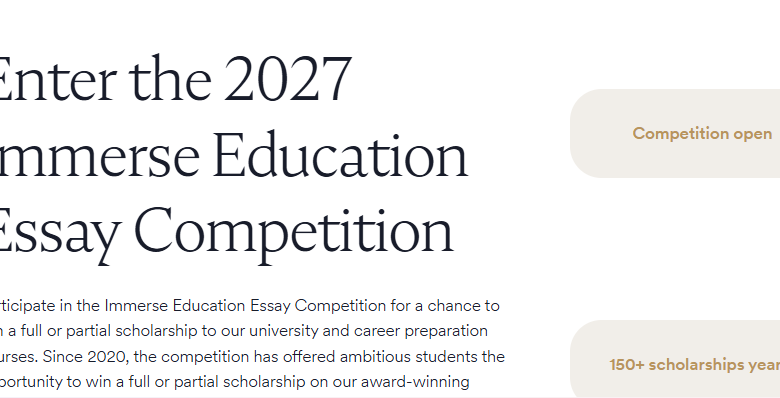
The Immerse Education Essay Competition 2027 offers ambitious students aged 13–18 an opportunity to demonstrate their academic abilities and compete for full or partial scholarships toward educational programmes offered by Immerse Education. Open to students worldwide, the competition encourages young learners to explore subjects of interest through structured academic writing, independent research, and critical analysis.
With the application deadline set for 25 October 2026, the competition provides a valuable opportunity for secondary school students seeking international academic exposure, scholarship opportunities, and preparation for future university studies.
Since its introduction, the competition has encouraged students to examine complex questions, develop independent arguments, and communicate ideas effectively. Successful participants may receive scholarships for residential summer programmes or online academic courses, with learning opportunities available in locations such as Oxford, Cambridge, London, New York, and Sydney. https://www.immerse.education/about/programmes/immerse-essay-competition
Scholarship Benefits and Awards
The competition offers several levels of recognition, making it attractive to students interested in academic enrichment and financial assistance for educational programmes.
1. Full Scholarships
Up to 10 full scholarships are awarded annually across the four Immerse competitions. Successful essay competition participants may receive a 100% scholarship toward an eligible Immerse Education course, subject to the competition’s award terms and conditions.
These awards can provide access to structured academic learning, subject-specific instruction, and opportunities to explore university-level topics beyond the traditional school curriculum.
2. Partial Scholarships
Outstanding entries that do not receive a full scholarship may qualify for partial scholarships covering up to 75% of eligible course fees. The award level depends on the quality and assessment grade of the submission.
Partial scholarships can reduce the cost of participating in an educational programme and help students access additional academic opportunities.
3. Participation Recognition
Students who submit valid entries can receive a participation award recognising their involvement and academic potential. This recognition may provide useful evidence of extracurricular academic engagement when preparing a student portfolio or discussing educational interests in future applications.
However, participation recognition should not be confused with a scholarship or a guarantee of university admission.
Who Can Apply for the Competition?
The Immerse Education Essay Competition welcomes applications from students across the world who meet the age requirements.
Eligible applicants must:
- Be aged 13–18 when the programme covered by the scholarship begins.
- Be interested in exploring an academic subject through essay writing.
- Be able to develop a clear argument and communicate ideas in English.
- Submit an original essay that follows the official competition guidelines.
Students from any country may participate, and previous enrolment in an Immerse Education course is not required. The competition is also free to enter, making it accessible to eligible students who wish to compete without paying an application fee.
Applicants should review the official eligibility requirements carefully, particularly if they are currently 18, because their age when the scholarship programme begins determines eligibility.
Eligible Subjects and Essay Topics
One of the most attractive features of the Immerse Education Essay Competition is its wide range of academic subjects. Rather than restricting participants to a single discipline, the competition allows students to select questions that match their interests and potential career ambitions.
Available subject areas include:
- Artificial Intelligence: Machine learning, algorithmic fairness, and strategies for reducing bias in AI systems.
- Fashion and Design: The influence of social media on fashion trends and consumer behaviour.
- Mathematics: The role of symmetry in a particular area of mathematical research.
- Engineering: Innovation, sustainable design, and the development of practical solutions.
- Philosophy: Consciousness, artificial intelligence, ethics, and the nature of the human mind.
- Law: Legal systems, fair trials, justice, and the protection of individual rights.
Other subjects may be available in the official essay guide. Participants can choose from the published questions or propose an original question where permitted by the competition guidelines.
Selecting a suitable topic is an important first step. A strong choice allows the student to demonstrate genuine curiosity, investigate credible evidence, and develop an argument that goes beyond a simple description of the subject.
How to Apply for the Immerse Education Essay Competition 2027
The application process involves several straightforward stages.
Step 1: Register Interest
Applicants should visit the official Immerse Education Essay Competition website and register their interest. Registration provides access to the essay competition guide, available questions, writing advice, referencing instructions, and relevant updates.
Official application page: https://www.immerse.education/about/programmes/immerse-essay-competition
Step 2: Choose an Essay Question
After reviewing the guide, participants should select a question that matches their interests and allows them to develop a focused argument.
A carefully selected question makes it easier to conduct relevant research and maintain a clear direction throughout the essay.
Step 3: Write a 500-Word Academic Essay
Applicants must prepare an essay responding directly to their chosen question. The official guidance permits a 10% allowance around the 500-word target, meaning submissions should generally contain between 450 and 550 words.
An effective essay should introduce the central issue, develop a logical argument, support important claims with reliable evidence, and conclude with a clear response to the question.
Step 4: Review and Proofread
Before submitting, participants should check their essay for factual accuracy, logical structure, spelling, grammar, punctuation, and correct referencing.
Original analysis is particularly important. Students should follow the competition’s rules concerning plagiarism, research, and the use of artificial intelligence. All submitted work should comply with the official requirements.
Step 5: Submit Before the Deadline
The completed essay must be uploaded through the official competition entry form by 25 October 2026. The competition allows one entry per person, and entries sent by email are not accepted under the published instructions.
Applicants are encouraged to complete the process early rather than waiting until the final day.
How Are Essays Judged?
Entries are assessed using criteria designed to evaluate academic thinking and writing ability. The published marking framework allocates points across five main areas:
- Communication of ideas — 30%: Clarity, organisation, originality, and effective expression.
- Word choice and structure — 20%: Vocabulary, sentence construction, coherence, and presentation.
- Critical analysis — 20%: Depth of understanding, evaluation of different perspectives, and quality of reasoning.
- Evidence and inference — 20%: Research quality, interpretation of information, and accurate referencing.
- Spelling, punctuation, and grammar — 10%: Technical accuracy and appropriate academic writing conventions.
These criteria demonstrate that successful essays require more than a general discussion of a topic. Students should build a defensible argument, examine evidence carefully, and explain why their conclusions follow from their research.
Why Should Students Participate?
The competition offers benefits beyond the possibility of winning a scholarship. Preparing an academic essay can strengthen research skills, independent thinking, written communication, and the ability to engage with university-level questions.
These skills can be valuable for future university applications, academic interviews, research projects, and other competitive educational opportunities. The competition may also help students identify subjects they wish to pursue in greater depth.
For students interested in international education, the opportunity to compete for a scholarship toward an Immerse Education programme provides an additional incentive to participate.
Important Dates to Remember
- Competition opening: 3 August 2026.
- Application deadline: 25 October 2026.
- Expected results announcement: 9 November 2026.
- Scholarship redemption deadline: 25 November 2026.
Applicants should consult the official competition website for the latest instructions and any applicable award conditions.
Final Thoughts
The Immerse Education Essay Competition 2027 represents a valuable academic opportunity for students aged 13–18 who want to develop their writing abilities, explore subjects beyond the classroom, and compete for educational scholarships.
With full scholarships, partial tuition support, and participation recognition available, the competition encourages young people to demonstrate curiosity, independent thinking, and academic potential.
Eligible students worldwide are encouraged to review the official guidelines, choose a compelling essay question, prepare an original and well-researched submission, and apply before 25 October 2026.