Finding the right research supervisor can be one of the most important steps for students planning to pursue a research-based Master’s degree or PhD. However, contacting professors requires more than sending the same generic email to dozens of academics.
The University of Virginia Security Research Group provides practical advice for prospective research students on how to identify suitable faculty members, prepare before making contact and write an effective introductory email. The guidance emphasises that students should focus on finding academics whose research genuinely matches their interests rather than contacting as many professors as possible.
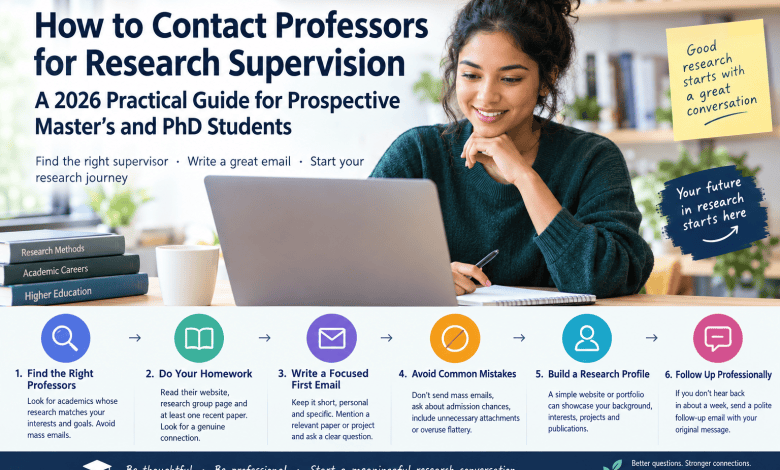
A 2026 Practical Guide for Prospective Master’s and PhD Students: Start by Identifying the Right Professors
Prospective students should first identify a small number of professors whose research closely matches their academic interests.
Instead of sending mass emails, applicants should research individual academics and determine whether their current research, publications and research group align with their proposed area of study.
A professor’s university profile, personal research website, laboratory page and recent publications can provide useful information about their current work.
Students should ask:
- Does the professor conduct research in the applicant’s area of interest?
- Are their recent publications relevant to the proposed research?
- Does the professor supervise postgraduate research students?
- Does their research group appear to be accepting new students?
- Can the applicant identify a genuine research connection?
The objective is to start a meaningful academic conversation rather than simply ask whether the professor can provide admission.
A 2026 Practical Guide for Prospective Master’s and PhD Students: Do Your Research Before Sending an Email
One of the most important recommendations is to do your homework before contacting a potential supervisor.
Students should read the professor’s research profile and, where possible, at least one recent research paper.
Reading a publication can help an applicant understand the professor’s specific research interests and identify a potential research question, extension or connection to their own academic background.
This also allows the student to write a personalised email rather than relying on statements such as, “I am interested in your research.”
A strong email should demonstrate that the applicant has actually looked at the professor’s work.
A 2026 Practical Guide for Prospective Master’s and PhD Students: Keep the First Email Short and Specific
A first email to a prospective supervisor should be concise and easy to read.
The message should normally include a brief introduction, the applicant’s academic background, the intended degree, the specific research work that attracted their attention and a clear question.
For example, a student could explain that they are completing a Bachelor’s or Master’s degree, intend to apply for a particular postgraduate programme and are interested in the professor’s research because of a specific paper or project.
The applicant can then briefly explain how that research connects with their own experience or proposed research interests.
A useful structure is:
Subject: Prospective PhD Student Interested in [Specific Research Area]
Greeting: Dear Professor [Surname],
Introduction: Briefly explain who you are, your current degree and the programme you are considering.
Research connection: Mention a specific paper, project or research topic by the professor.
Your connection: Explain briefly how the research relates to your academic background or proposed research.
Question: Ask whether the professor would be open to discussing potential supervision or whether the proposed research direction may fit their group.
Closing: Thank the professor for their time and provide your name and email address.
Demonstrate Interest Through Substance
Prospective students do not need to tell professors that they are hardworking, intelligent or highly motivated.
Instead, the content of the email should demonstrate these qualities.
For example, mentioning a specific finding from a recent paper and asking a thoughtful question about a possible extension can demonstrate genuine engagement with the professor’s research.
Applicants should avoid excessive praise. Showing that they have taken the time to understand the professor’s work is generally more useful than describing the professor as “the world’s leading expert.”
A 2026 Practical Guide for Prospective Master’s and PhD Students: What Students Should Avoid
Several common mistakes can reduce the effectiveness of a supervisor-contact email.
Avoid mass emails: Sending identical messages to large numbers of professors can appear impersonal and may damage the applicant’s credibility.
Do not write a long life story: The first email should contain only information relevant to the proposed research and postgraduate study.
Do not ask about admission chances: Professors generally cannot determine an applicant’s admission prospects from a short email containing grades or test scores.
Do not focus excessively on grades: Academic results may form part of the formal application, but the initial supervisor email should focus on research fit and academic interests.
Do not use generic statements: Saying “your research aligns perfectly with my interests” without identifying a specific connection does not tell the professor much.
Avoid unnecessary attachments: The source recommends providing additional information through a professional website or relevant online research portfolio rather than attaching numerous documents to an initial email.
Avoid complicated formatting: A simple, professional email is preferable to elaborate fonts, graphics or formatting.
Create a Professional Research Profile
Students who have research experience can consider creating a simple professional website or research portfolio.
The website can include information such as:
- Academic background
- Research interests
- Research projects
- Publications or working papers
- Conference presentations
- Relevant technical projects
- Professional contact information
A research portfolio gives a prospective supervisor somewhere to learn more about the applicant without making the first email unnecessarily long.
Students should ensure that everything linked from the email is professional, relevant and up to date.
Follow Up Professionally
Professors can receive large volumes of email, so a lack of response does not necessarily mean that the message was rejected.
If there is no response after approximately one week, applicants can send a short and polite follow-up message.
The follow-up should include the original email so the professor can quickly understand the context.
If there is still no response, students can move on to other potential supervisors rather than repeatedly sending messages.
The Goal Is to Start a Research Conversation
The purpose of contacting a professor should not simply be to ask, “Will you accept me?”
A more productive objective is to start a conversation about research.
Applicants should demonstrate that they have identified a genuine connection between their interests and the professor’s work and ask a clear question about whether that research direction could be worth exploring.
For prospective Master’s and PhD students, this approach can help them identify academics whose research interests, expertise and supervision arrangements align with their own academic goals.
Final Tips Before Sending Your Email
Before pressing send, prospective students should check that:
- The professor’s name and institution are correct.
- The email is personalised.
- A specific publication or research project is mentioned.
- The connection between the professor’s work and the applicant’s interests is clear.
- The message is concise.
- The applicant has asked one clear question.
- Spelling and grammar have been checked.
- The email address and signature are professional.
- Any research portfolio or website link works correctly.
Most importantly, applicants should remember that quality and research fit matter more than the number of professors contacted.
A carefully researched, concise and personalised email can provide a much stronger starting point for a potential supervisor relationship than a generic message sent to dozens of academics.