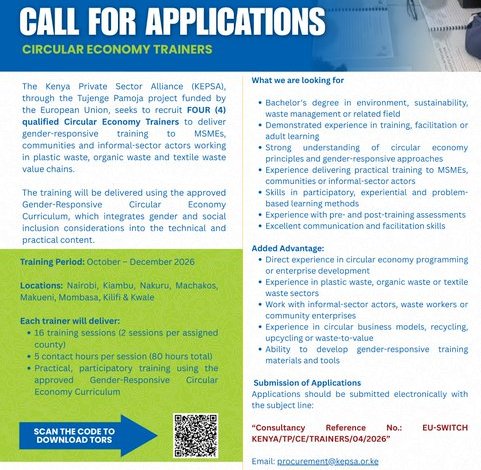
The EU-SWITCH Kenya – Tujenge Pamoja Project has announced a Call for Applications for four Circular Economy Trainers to support the delivery of practical training to micro, small and medium-sized enterprises (MSMEs), communities and informal-sector actors across Kenya.
The trainers will be engaged from October to December 2026 to deliver structured training under the programme’s approved Gender-Responsive Circular Economy Curriculum. The initiative focuses on strengthening circular economy practices across plastic waste, organic waste and textile waste value chains.
Interested professionals have until 22 September 2026 to submit their applications.
EU-SWITCH Kenya Circular Economy Trainers 2026
The EU-SWITCH Kenya – Tujenge Pamoja Project is designed to advance Kenya’s circular economy by supporting MSMEs and other actors to adopt more sustainable approaches to production, resource use and waste management.
The four selected trainers will deliver practical and participatory learning designed to help participants understand circular economy principles and apply them within their enterprises and communities.
The training curriculum incorporates gender equality and social inclusion, ensuring that women, youth and other groups that may experience barriers to participation are meaningfully included.
Each selected trainer will be responsible for delivering 16 training sessions, with two sessions conducted in each assigned county. Every session will involve five contact hours, resulting in a total commitment of 80 contact hours per trainer.
Training Locations and Duration
The assignment is scheduled to run from mid-October through December 2026.
Training will take place across the programme’s eight target counties:
- Nairobi
- Kiambu
- Nakuru
- Machakos
- Makueni
- Mombasa
- Kilifi
- Kwale
Applicants are expected to indicate their availability to undertake assignments within these geographical areas.
The selected trainers will work with MSMEs, community groups and informal-sector actors, adapting their delivery methods to the needs and circumstances of different adult learners.
Key Responsibilities
Circular Economy Trainers will be expected to prepare and deliver training in line with the approved curriculum and programme schedule.
Key responsibilities include:
- Delivering assigned circular economy training sessions.
- Facilitating practical learning on circular economy principles and circular business models.
- Training participants on resource efficiency, waste reduction and waste-to-value opportunities.
- Applying concepts to plastic, organic and textile waste value chains.
- Providing relevant local examples and business cases.
- Using demonstrations, practical exercises, case studies and group problem-solving.
- Supporting peer learning and field-based activities where appropriate.
- Adapting training to MSMEs, communities and informal-sector participants.
- Promoting meaningful participation of women, youth and other underserved groups.
- Conducting pre- and post-training assessments.
- Maintaining accurate training records.
- Preparing session reports, assessment results and lessons learned.
What the Training Will Cover
The approved Gender-Responsive Circular Economy Curriculum will provide participants with both technical knowledge and practical approaches for adopting circular practices.
Core areas include circular economy principles and the business case for transitioning from linear to circular models. Participants will also explore resource efficiency, waste reduction and the sustainable use of water and energy.
The curriculum will cover circular business models and opportunities for value addition, alongside practices specific to plastic waste, organic waste and textile waste.
Environmental governance and regulatory compliance will also feature in the training. This includes relevant requirements under Kenya’s Sustainable Waste Management Act, 2022, Extended Producer Responsibility Regulations, 2024, NEMA and KEBS.
Where relevant, participants will also be introduced to product development, human-centered design, prototyping and testing of circular solutions.
Qualifications and Experience
Applicants should hold a Bachelor’s degree in environment, environmental science, natural resource management, sustainability, waste management or another relevant field.
Candidates must also demonstrate professional experience in training, facilitation or adult learning and possess a strong understanding of environmental sustainability and gender-responsive circular economy principles.
Relevant experience should include delivering practical and interactive training to MSMEs, communities, informal-sector actors or other adult learners.
Applicants should also demonstrate experience with participatory, experiential and problem-based learning approaches, as well as experience administering pre- and post-training assessments or other learning assessment tools.
Strong communication, facilitation and interpersonal skills are required.
Additional Experience That May Strengthen an Application
The programme identifies several areas of additional experience that may provide an advantage.
These include direct experience in circular economy programming or enterprise development, as well as experience working within one or more of the targeted plastic, organic or textile waste value chains.
Experience with informal-sector actors, community enterprises, waste workers, artisans and small businesses is also relevant.
Applicants with knowledge of circular business models, resource efficiency, waste-to-value, reuse, repair, recycling or upcycling may be particularly suited to the assignment.
Experience developing practical training materials, exercises, case studies or assessment tools that are gender-responsive and accessible to diverse participants is also advantageous.
How to Apply
Interested candidates should prepare an updated Curriculum Vitae highlighting their relevant qualifications and professional experience.
Applications should also include a brief Expression of Interest explaining the candidate’s suitability, particularly their experience in circular economy, environmental training and practical engagement with MSMEs, communities or informal-sector actors.
Applicants should provide examples of relevant training assignments they have undertaken, together with three professional references.
Applications must be submitted electronically using the subject line:
“Consultancy Reference No.: EU-SWITCH KENYA/TP/CE/TRAINERS/04/2026”
Applications should be sent by email no later than 22 September 2026.
Only shortlisted applicants will be contacted.
Application Deadline
The deadline for the EU-SWITCH Kenya Circular Economy Trainers opportunity is 22 September 2026. Qualified environmental, sustainability, waste management and adult-learning professionals who meet the requirements are encouraged to prepare their application materials early and clearly demonstrate their practical training experience and knowledge of circular economy approaches.