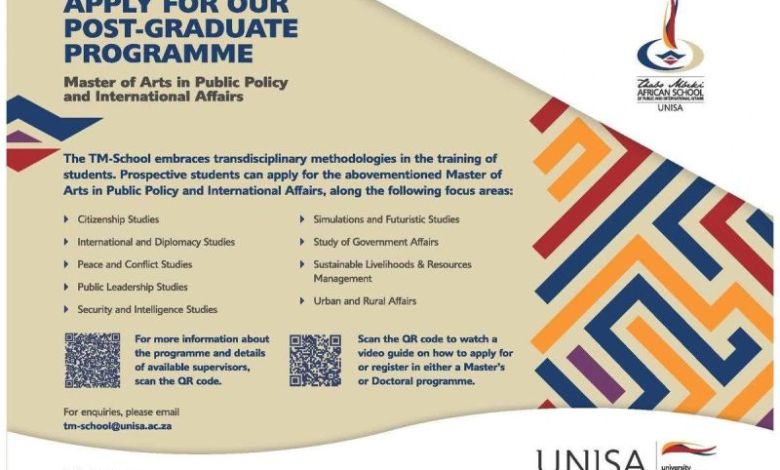
Applications are now open for the Master of Arts (MA) and Doctor of Philosophy (PhD) in Public Policy and International Affairs at the University of South Africa (UNISA).
The programmes are designed for researchers and professionals interested in examining major governance, policy, security, development and international affairs challenges affecting Africa and the wider world.
Applications for the 2026 intake are open from 1 September to 20 November 2026, giving eligible prospective students an opportunity to pursue advanced research in areas connected to African governance, diplomacy, public leadership, peace and conflict, sustainable livelihoods and security.
Unlike conventional taught postgraduate programmes, these degrees are structured around independent dissertation research. Students are expected to develop original, theoretically grounded and empirically based research that contributes meaningfully to public policy and international affairs.
About the UNISA Public Policy and International Affairs Programmes
The Master of Arts and Doctor of Philosophy programmes provide an advanced research pathway for individuals seeking to engage critically with complex public policy and international affairs questions.
The programmes are particularly relevant to applicants who want to investigate pressing issues affecting governments, communities, institutions and international relations.
Rather than focusing primarily on classroom-based coursework, the programmes place substantial emphasis on research and dissertation development. This approach allows students to investigate a carefully defined research problem while developing advanced analytical and academic skills.
For professionals, researchers and academics interested in influencing policy and contributing to knowledge production, the programmes can provide a platform for examining real-world challenges through rigorous research.
A Dissertation-Focused Postgraduate Opportunity
One of the defining features of the programmes is their dissertation-based structure.
Students will be expected to identify an important research problem, engage with relevant theoretical and empirical literature, undertake appropriate research and develop an original academic contribution.
This makes the programmes particularly suitable for individuals who already have a strong interest in research and are prepared to undertake independent academic work.
The emphasis on original research also provides an opportunity for students to investigate issues that are directly relevant to African societies, public institutions, development processes and international relations.
Nine Research Focus Areas
Applicants can explore research questions across nine focus areas, providing considerable flexibility for students with different academic and professional interests.
1. Citizenship
Research in this area can examine citizenship, identity, participation, rights and the relationship between individuals and public institutions.
2. Public Leadership
This focus area provides an opportunity to explore leadership, governance, public-sector decision-making and institutional effectiveness.
3. Peace and Conflict
Students interested in conflict prevention, peacebuilding, political instability and approaches to sustainable peace can develop research within this area.
4. Government Affairs
Government affairs research can examine public institutions, policy processes, governance systems and the relationship between governments and other stakeholders.
5. Urban and Rural Affairs
This area provides space to investigate challenges affecting urban and rural communities, including governance, development, inequality and access to resources and opportunities.
6. Simulation and Futuristic Studies
Students can explore emerging scenarios, future challenges, simulations and approaches for understanding how societies and institutions may respond to changing conditions.
7. Security and Intelligence
Research may focus on security challenges, intelligence, national and regional security dynamics and emerging threats affecting societies and states.
8. Sustainable Livelihoods and Resource Management
This research area is relevant to applicants interested in sustainable development, natural resources, livelihoods, environmental challenges and community resilience.
9. International and Diplomacy Affairs
Students interested in international relations, diplomacy, foreign policy and Africa’s engagement with the global community can develop research within this focus area.
Who Should Consider Applying?
The programmes may be particularly suitable for individuals seeking advanced research training in public policy and international affairs.
Potential applicants include researchers, policy professionals, public-sector practitioners, development specialists, diplomats, governance professionals, academics and other individuals with relevant academic interests.
Because the programmes are dissertation-focused, applicants should be prepared to undertake independent research and develop an academically rigorous research project.
Prospective students should carefully review UNISA’s official admission requirements for the specific qualification before applying, including the academic requirements applicable to Master’s and PhD applicants.
Public policy and international affairs have become increasingly important as African countries navigate complex challenges involving governance, peace and security, economic development, urbanisation, resource management and international cooperation.
Advanced research in these areas can contribute to evidence-based policymaking and help improve understanding of the factors shaping African societies and institutions.
For students with a long-term interest in academia, policy research, government, international organisations or development work, a dissertation-based postgraduate qualification can provide an opportunity to build specialised expertise.
Application Timeline
Applications for the advertised 2026 intake are open from:
Opening date: 1 September 2026
Closing date: 20 November 2026
Applicants should avoid waiting until the final days of the application period. Preparing academic documents, identifying an appropriate research direction and reviewing admission requirements can take considerable time.
How to Apply
Interested applicants should visit the University of South Africa and review the official admission information for the relevant Master’s or PhD programme.
Applicants should ensure that they understand the qualification requirements and prepare all required supporting documentation before submitting their applications.
Because these are research-intensive programmes, prospective students should also give careful consideration to the research topic they intend to pursue and ensure that it aligns with one of the programme’s focus areas.
Key Details
- Institution: University of South Africa (UNISA)
- Programmes: Master of Arts and Doctor of Philosophy in Public Policy and International Affairs
- Study level: Master’s and PhD
- Programme format: Dissertation/research-focused
- Application period: 1 September – 20 November 2026
- Research areas: Nine focus areas
- Fields: Governance, public leadership, peace and conflict, security, sustainable livelihoods, international affairs and diplomacy
- Target applicants: Prospective postgraduate researchers and professionals meeting UNISA’s admission requirements
Conclusion
The UNISA Master’s and PhD programmes in Public Policy and International Affairs offer prospective researchers an opportunity to investigate some of the most pressing governance, policy and international affairs challenges facing Africa.
With nine research focus areas and a strong emphasis on producing original dissertation research, the programmes can appeal to individuals seeking to advance their academic expertise while contributing evidence and ideas to important policy debates.
Eligible applicants interested in African governance, public policy, diplomacy, security, peace and conflict, sustainable development or international affairs are encouraged to review the official UNISA requirements and submit their applications before 20 November 2026.