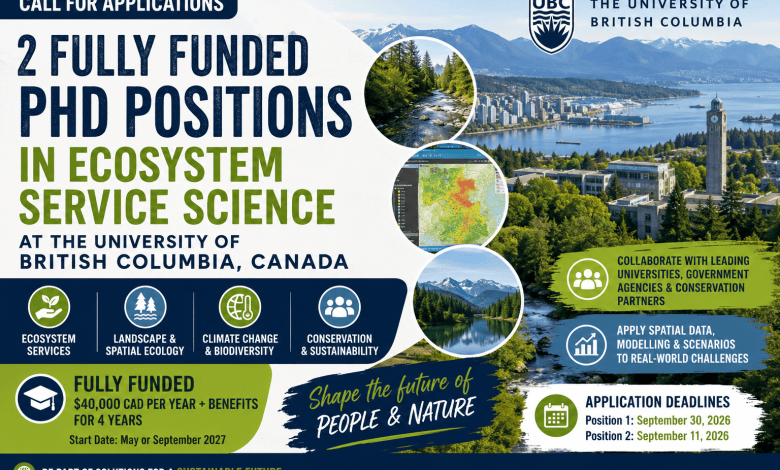
The University of British Columbia (UBC) is inviting applications for two fully funded PhD positions in Ecosystem Service Science through the Multifunctional Ecosystems for Sustainable Human & Nature Landscapes (MESH) Lab. Led by Dr. Matthew Mitchell in the Department of Forest Resources Management, the research opportunities are expected to begin in May or September 2027.
Both PhD positions offer a guaranteed stipend of CAD $40,000 per year, plus benefits, for four years. The successful candidates will join collaborative research projects examining the relationships between ecosystems, biodiversity, climate change, land use, conservation and human well-being.
The positions are based at the University of British Columbia’s Point Grey campus in Vancouver, Canada, with some travel within Canada expected for collaboration with project partners.
Research Opportunity One: Forest Harvesting, Retention and Watershed Ecosystem Services
The first funded PhD position will investigate the impacts of forest harvesting and retention schemes on watershed-scale ecosystem services.
The successful candidate will join a collaborative nature-based solutions project involving UBC, Carleton University, Tree Canada, Environment and Climate Change Canada, Natural Resources Canada, the Ontario Ministry of Natural Resources and other partners.
The wider project aims to improve understanding of biodiversity and human well-being outcomes associated with forests as nature-based solutions across different contexts.
The PhD research will specifically explore the relationships between watershed-scale forest harvesting and retention regimes, freshwater biodiversity and ecosystem services.
The selected student will integrate ecosystem service modelling with land use change modelling to examine how multiple ecosystem services may respond to future forest harvesting and land use change.
This opportunity may be particularly suitable for candidates interested in:
- Landscape ecology
- Spatial ecology
- Social-ecological systems
- Ecosystem services
- Forest management
- Conservation science
- Land use change modelling
- Freshwater biodiversity
The position will also provide opportunities to contribute to national-scale forest management planning in collaboration with Environment and Climate Change Canada and Natural Resources Canada. Research findings may additionally support smaller-scale management decisions alongside other project partners.
The successful candidate will be based in Vancouver and may travel within Canada to meet and collaborate with project partners.
Research Opportunity Two: Future Scenarios and Conservation Prioritization for Ecosystem Services
The second funded PhD position will focus on future scenarios and conservation prioritization for ecosystem services in Canada.
The successful candidate will join a collaborative landscape ecology project involving UBC, the Nature Conservancy of Canada and Metro Vancouver regional authority.
This research project will investigate how future land use and land cover change, together with climate change, could affect social-ecological landscape connectivity and ecosystem services across Canada.
The PhD student will examine how potential future climate and land use or land cover changes may affect the delivery of ecosystem services. The research will then explore where conservation actions should be prioritized to maintain ecosystem service connectivity and provision.
The project will combine several research approaches, including:
- Land use scenario development
- Mapping future environmental changes
- Modelling climate change impacts on ecosystems
- Ecosystem service analysis
- Landscape connectivity research
- Conservation prioritization
The findings are expected to help identify critical areas for ecosystem service conservation and support future conservation planning.
This position may be particularly relevant for students with interests in landscape or spatial ecology, social-ecological systems, climate science, ecosystem services or conservation prioritization.
The successful candidate will also have opportunities to contribute to conservation planning at the national level through collaboration with the Nature Conservancy of Canada, as well as regional-scale work with Metro Vancouver.
Eligibility and Required Qualifications
Applicants for both PhD positions should have completed an MSc degree in a relevant discipline.
Suitable academic backgrounds include ecology, landscape ecology, spatial ecology, social-ecological systems and forestry. Candidates with related qualifications in conservation biology, environmental science, land system science or geography may also be considered.
Essential qualifications include:
- An MSc degree in a relevant field
- Strong interest in ecosystem services, conservation science or forest management
- Strong teamwork and communication skills
- Strong written and oral communication abilities
- Some data management and analysis experience
- Basic GIS or spatial analysis skills
- A proactive approach to learning new software and modelling methods
Candidates with additional technical experience may have an advantage, although several of the listed qualifications are preferred rather than required.
Preferred skills may include advanced GIS or spatial analysis, familiarity with land use and land cover datasets, raster analysis and landscape structure metrics.
Experience using R for data manipulation and analysis may also be beneficial.
Applicants may additionally have experience with ecosystem service models such as InVEST or ARIES, as well as land use or land cover scenario development.
For the conservation prioritization PhD, experience with conservation planning approaches or software such as MARXAN or the prioritizr R package may also be an advantage.
Funding and Benefits
Both successful PhD candidates will receive a guaranteed stipend of CAD $40,000 per year plus benefits for four years.
Students will also be expected to apply for relevant external funding opportunities and will receive support in doing so. Potential funding opportunities may include awards such as those offered through NSERC and other relevant scholarship programmes.
The funded positions provide students with the opportunity to undertake advanced doctoral research while working alongside academic institutions, government agencies, conservation organizations and other partners involved in ecosystem and environmental management.
Application Requirements
Interested candidates should contact Dr. Matthew Mitchell by email.
Applicants should submit their materials as a single PDF attachment containing:
- A one-page cover letter explaining their interest in the position and relevant experience or qualifications
- A CV or resume
- Undergraduate transcripts, with unofficial transcripts accepted
- One writing sample
- Contact information for two references
Applications will continue to be reviewed until the positions are filled. However, candidates are encouraged to apply by the stated deadlines to receive full consideration.
For the PhD position on forest harvesting, retention schemes and watershed-scale ecosystem services, candidates should submit their application by September 30, 2026.
For the PhD position on future scenarios and conservation prioritization for ecosystem services, candidates should submit their application by September 11, 2026.
The projects are expected to begin in May or September 2027, depending on the specific position and arrangements with the successful candidate.
Who Should Apply?
These opportunities are particularly suited to aspiring researchers seeking to build careers in ecosystem service science, landscape ecology, forest management, climate change research or conservation planning.
Candidates who are interested in applying advanced spatial analysis and modelling approaches to real-world environmental challenges may find both positions especially relevant.
The research also provides opportunities to engage with major questions around how forests and landscapes can support biodiversity, ecosystem services and human well-being as climate and land use continue to change.
Although all qualified candidates are encouraged to apply, Canadians and permanent residents of Canada may be given priority.
The MESH Lab particularly encourages applications from members of marginalized or minority groups. This includes individuals from historically underrepresented communities and candidates from diverse backgrounds.
Final Note
These two fully funded PhD opportunities at the University of British Columbia offer an opportunity to conduct high-impact research at the intersection of ecology, conservation, climate change, spatial analysis and ecosystem services.
With four years of guaranteed funding worth CAD $40,000 annually plus benefits, successful candidates will join collaborative projects involving leading universities, government agencies, conservation organizations and environmental partners.
Interested applicants should carefully review the requirements for their preferred project and contact Dr. Matthew Mitchell with their application materials before the relevant deadline.