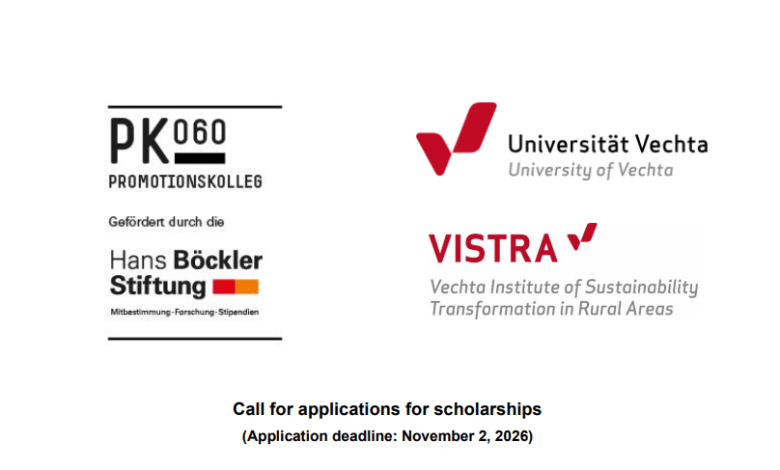
The University of Vechta in Germany is inviting applications for up to three PhD scholarships under its doctoral college focusing on “Justice Dimensions of Sustainability-Oriented Transformation Processes in Rural Areas.”
The doctoral scholarships are funded by the Hans Böckler Foundation and are designed for researchers interested in the social, economic, environmental and ethical dimensions of sustainability transformations in rural communities.
The programme provides an opportunity for doctoral researchers to investigate how sustainability-oriented transformations affect different groups and communities, with particular attention to social justice, inequality, risk and uncertainty.
Successful scholarship holders will receive €1,650 per month, with possible additional support for health insurance and family allowances. The scholarships can run for up to three years, with the programme expected to begin between June and September 2027.
The application deadline is 2 November 2026.
The doctoral college is affiliated with the Vechta Institute of Sustainability Transformation in Rural Areas (VISTRA) and examines the justice dimensions of sustainability-oriented transformation processes.
Sustainability transformations are often presented as necessary for addressing environmental and climate challenges. However, these transformations can also create social and economic consequences for individuals and communities.
The doctoral college seeks to better understand these consequences and explore how transformation processes can be designed in ways that are more equitable and socially just.
The programme uses a comparative case-study approach involving multiple dissertation projects. Through interdisciplinary collaboration, doctoral researchers will contribute to the development of a common theoretical framework for understanding justice in sustainability-oriented transformations.
3 PhD Scholarships in Germany at the University of Vechta: Research Topics
Applicants are encouraged to develop research projects connected to questions of justice within sustainability-oriented transformation processes in rural areas.
Potential research themes include:
- Energy affordability and new inequalities between urban and rural areas.
- Spatial justice, equitable livelihoods and social places.
- Local resilience and sustainability transformations.
- Risk, uncertainty and perceptions of injustice.
- Justice in socio-technical transitions and innovation.
- Digitalization and the bioeconomy.
- Nature and climate protection policies.
- Urban-rural relationships.
- Relationships between the Global North and Global South.
- Gender justice in transformation processes.
- The role of trade unions in shaping just sustainability transformations.
- Ethical and normative uncertainty in sustainability transformations.
Applicants may also propose other research topics that fall within the broader theme of justice and sustainability-oriented transformation processes.
3 PhD Scholarships in Germany at the University of Vechta: Relevant Academic Disciplines
The doctoral college is interdisciplinary and welcomes applicants from a range of academic backgrounds.
Relevant disciplines include:
- Human geography
- Social sciences
- Applied ethics
- Economics
- Sustainability science
- Psychology
- Political science
- Environmental studies
- Related interdisciplinary fields
Both qualitative and quantitative research approaches are welcome. The programme specifically encourages quantitative and mixed-methods research.
This interdisciplinary structure allows doctoral researchers to approach sustainability challenges from different theoretical and methodological perspectives.
Scholarship Funding and Duration
The PhD scholarships provide financial support of €1,650 per month.
Additional support may be available in the form of health insurance and family allowances, depending on the applicable conditions.
The scholarship can be awarded for up to three years.
The expected starting period is between June and September 2027.
An important advantage for international applicants is that the dissertation can be written in English, making the programme accessible to researchers who may not be conducting their doctoral research in German.
Doctoral Training and International Collaboration
Scholarship holders will become part of a structured doctoral programme designed to support their academic and professional development.
The doctoral college offers thematic and methodological workshops, regular academic exchange and opportunities for mutual learning among doctoral researchers.
The programme also works with national and international research partners, creating opportunities for research stays, co-supervision, networking and collaboration.
Partners include institutions such as the Copernicus Institute of Sustainable Development at Utrecht University, Leibniz Centre for Agricultural Landscape Research, Leuphana University Lüneburg, Karlsruhe Institute of Technology, LUCSUS – Centre for Sustainability Studies at Lund University, Basque Centre for Climate Change and the University of Vermont.
These partnerships can provide doctoral researchers with opportunities to engage with wider international research communities.
Who Should Apply?
The opportunity is particularly suited to prospective PhD researchers who are interested in the intersection of sustainability, social justice and rural transformation.
Applicants should be able to develop a strong research proposal that contributes to the overarching objectives of the doctoral college.
Those working on questions involving environmental policy, climate change, energy transitions, rural development, inequality, gender, digital transformation, social resilience, ethics or governance may find the programme particularly relevant.
Applicants are also encouraged to contact the relevant academic supervisors before submitting their applications to discuss their proposed research projects.
Contact Potential Supervisors
Prospective applicants are encouraged to discuss their research ideas with members of the doctoral college in advance.
Relevant contacts include Prof. Dr. John-Oliver Engler, whose research interests include bioeconomy and resource efficiency, and Prof. Dr. Jana Zscheischler.
Content-related questions can also be directed to Dr. Judith-Maria Maruschke, the coordinator of the doctoral college.
Early contact can help applicants determine whether their proposed research fits the thematic scope of the programme and identify appropriate academic guidance before submitting the application.
Application Process
Applications must be submitted exclusively through the Hans Böckler Foundation’s online application portal.
Applicants should carefully review the official application requirements and prepare their research project outline and supporting materials according to the foundation’s instructions.
The application deadline is:
2 November 2026
The successful scholarship recipients are expected to be announced in May 2027.
Applicants with questions about the application process can contact while content-related questions can be directed to the relevant University of Vechta doctoral college contacts.
Key Scholarship Details
| Opportunity | Details |
|---|---|
| University | University of Vechta, Germany |
| Programme | Doctoral College – Justice Dimensions of Sustainability-Oriented Transformation Processes in Rural Areas |
| Scholarships | Up to 3 |
| Funding body | Hans Böckler Foundation |
| Funding | €1,650 per month |
| Additional support | Possible health insurance and family allowances |
| Duration | Up to 3 years |
| Start date | Between June and September 2027 |
| Dissertation language | English permitted |
| Research areas | Sustainability, justice, rural transformation and related fields |
| Methods | Qualitative, quantitative and mixed methods |
| Application deadline | 2 November 2026 |
| Expected scholarship announcement | May 2027 |
How to Apply
Interested candidates should review the full programme and application requirements before preparing their research proposal.
University of Vechta Doctoral College information
Applications must be submitted through the Hans Böckler Foundation’s online application process.
Hans Böckler Foundation application information
The opportunity provides prospective doctoral researchers with the chance to pursue research into some of the most important questions surrounding sustainability, rural development, inequality and social justice, while receiving financial support and participating in an interdisciplinary international research network.