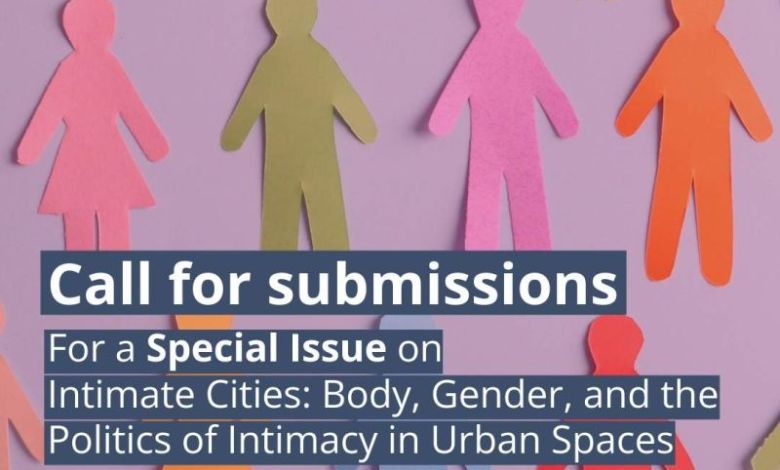
The Journal of Gender Studies, published by Taylor & Francis, is inviting scholarly contributions for a special issue titled “Intimate Cities: Body, Gender, and the Politics of Intimacy in Urban Spaces.”
How do gender, bodies, desire, vulnerability and everyday encounters shape the way people experience cities? Researchers across sociology, gender studies, urban studies, cultural studies and related disciplines are invited to explore these questions in a new special issue of the Journal of Gender Studies.
The call provides an opportunity for researchers to examine the relationship between intimacy, gender and urban environments, moving beyond conventional understandings of intimacy as something restricted to romantic relationships or private spaces.
The deadline for submitting abstracts is 28 September 2026, while selected contributors will be expected to submit their full-length manuscripts by 15 March 2027.
Why Study Intimacy in the City?
Cities are often described as places of freedom, anonymity, mobility and opportunity.
But the experience of urban life is not the same for everyone.
For gendered, queer, migrant and marginalised bodies, the city can also be a place of surveillance, regulation, vulnerability and constant negotiation. Moving through a crowded bus, entering a workplace, walking through a park, seeking healthcare or using a digital platform can all involve complex negotiations around personal boundaries, safety, identity and belonging.
The special issue therefore asks researchers to consider an important question:
How do everyday urban spaces shape intimate bodily experiences, and how do gendered forms of intimacy, in turn, reshape the meaning of the city?
The call understands intimacy in broad and inclusive terms. It can involve emotional closeness, bodily vulnerability, care, fear, pleasure, self-regulation, solitude and the everyday work of navigating urban life.
This perspective opens opportunities for scholars to investigate intimacy across both public and private spaces.
From Public Transport to Digital Spaces
Urban intimacy can emerge in places that may not traditionally be considered intimate.
Public transport, for example, places strangers in close physical proximity and can create complicated negotiations around touch, personal space and safety.
Workplaces can similarly become sites where professional relationships intersect with gender, power, bodies and personal boundaries.
Homes raise questions about domesticity, care, privacy and gendered labour.
Meanwhile, dating applications, social media and other digital platforms increasingly create new forms of urban intimacy, allowing people to establish relationships and negotiate identity through spaces that connect the digital and physical city.
The special issue encourages scholars to examine these different environments and the ways they influence how people experience their bodies, relationships and identities.
A Strong Interdisciplinary Research Opportunity
The call is particularly relevant to researchers working across disciplines.
Contributions are welcomed from scholars in:
- Sociology
- Gender Studies
- Urban Studies
- Cultural Studies
- Literature
- Queer Studies
- Migration Studies
- Anthropology
- Urban Geography
- Media and Digital Studies
- Related interdisciplinary fields
The editors are seeking contributions that offer critical perspectives on intimacy, labour, urban landscapes, vulnerability and gendered experiences.
Researchers may use theoretical, qualitative, ethnographic, literary, cultural or other appropriate approaches, provided that their proposed papers clearly engage with the central concerns of the special issue.
Key Research Themes
The special issue welcomes papers addressing a broad range of topics.
Gender, Bodies and Public Space
Researchers could explore how people negotiate bodily proximity and personal boundaries in public spaces such as public transport, parks, workplaces and clinics.
Questions of unwanted touch, harassment, safety and everyday strategies for navigating urban environments are particularly relevant.
Gender and Surveillance
Urban surveillance can affect bodies differently according to gender, sexuality, migration status, race, class and other social identities.
Contributors may investigate how policing, security systems, urban design and social norms regulate bodies and influence people’s ability to move freely through cities.
Queer and Trans Intimacies
The special issue also creates space for research into queer and trans experiences of urban intimacy.
Potential contributions could examine how cities create opportunities for community, connection and self-expression while simultaneously producing forms of exclusion, surveillance or vulnerability.
Digital and Urban Intimacies
Dating apps, social media and digital platforms have transformed how people meet, communicate and form relationships.
Researchers may examine how these technologies reshape intimacy and how digital interactions intersect with physical urban environments.
Migration and Displacement
Migrants may experience cities through complex relationships between mobility, belonging, displacement, work, housing and vulnerability.
Research could explore how migration status shapes access to intimate relationships, community, safety and urban space.
Domesticity, Pleasure and Desire
The call also welcomes research examining intimacy within homes and other private spaces, as well as the relationships between urban environments, pleasure, desire and embodied experiences.
An Intersectional Approach to Urban Life
A central strength of the call is its emphasis on intersectionality.
Gender does not operate independently of other forms of social identity and inequality.
The special issue encourages researchers to consider how experiences of urban intimacy are shaped by caste, class, race, sexuality, disability, age, migration status and religion.
This approach recognises that there is no single experience of the gendered city.
The same street, transport system, workplace or neighbourhood can produce radically different experiences depending on who is occupying that space.
Theoretical Foundations
The special issue builds on feminist and gender scholarship that has challenged conventional distinctions between public and private life.
The work of scholars including Doreen Massey, Elizabeth Wilson and Lauren Berlant has demonstrated how gender and power influence people’s experiences of public and private spaces.
The call also draws attention to scholarship on masculinity and urban environments, including work by Sanjay Srivastava, as well as Romit Chowdhury’s ethnographic analysis of public transport infrastructures in Kolkata and the intersections between mobility, heterosexual masculinity and spatial politics.
Contributors are encouraged to engage critically with relevant scholarship while bringing new theoretical, empirical or cultural perspectives to the discussion.
Who Should Submit?
The opportunity could be particularly valuable for:
- PhD researchers
- Early-career researchers
- Postdoctoral scholars
- University lecturers
- Sociologists
- Gender studies researchers
- Urban researchers
- Cultural studies scholars
- Migration researchers
- Queer studies scholars
- Interdisciplinary researchers
Researchers whose work focuses on gender, migration, sexuality, mobility, labour, public space, digital culture, housing, urban life or embodied experiences may find particularly strong connections to the special issue.
Submission Requirements
Interested authors must submit:
A 250–300-word abstract explaining the proposed paper and clearly demonstrating how it contributes to understanding intimacy and urban spaces in relation to gender studies, cultural studies or related fields.
Authors must also provide a short biographical note of no more than 100 words.
Abstracts should be submitted to the three guest editors:
Dr. Debadrita Chakraborty, Assistant Professor, Department of English and Other Languages and Faculty Fellow, Centre for Asian Studies Fellow, GITAM University, Hyderabad, Telangana, India
chakrabortydebadrita19@gmail.com
Dr. Sanjana Chakraborty, Assistant Professor, Department of English and Other Languages and Faculty Fellow, Centre for Asian Studies Fellow, GITAM University, Visakhapatnam, Andhra Pradesh, India
s.chakraborty090296@gmail.com
Dr. Aritra Saha, Assistant Professor, Department of English and Other Languages and Faculty Fellow, Centre for Asian Studies Fellow, GITAM University, Bengaluru, Karnataka, India
asaha2@gitam.edu
Following the selection of abstracts, invited authors will submit their full-length manuscripts according to the Journal of Gender Studies author guidelines.
Important Deadlines
Abstract deadline: 28 September 2026
Full manuscript deadline: 15 March 2027
Authors whose abstracts are accepted should select “Intimate Cities: Body, Gender, and the Politics of Intimacy in Urban Spaces” when submitting their full paper through the journal’s submission portal.
An Opportunity to Rethink the City Through Gender and Intimacy
This special issue offers an opportunity to challenge the idea that cities are simply physical environments defined by buildings, infrastructure and transport systems.
Cities are also lived through bodies.
They are spaces where people encounter strangers, negotiate boundaries, experience desire and fear, seek care, establish relationships, manage vulnerability and construct identities.
By placing intimacy at the centre of urban analysis, the special issue invites scholars to explore how gender and power influence the most ordinary experiences of city life.
For researchers working at the intersection of gender, sociology, urban studies, migration, sexuality, culture and embodied experience, this call provides an opportunity to contribute to an important interdisciplinary scholarly conversation.
Abstract deadline: 28 September 2026.
The city is more than a place people inhabit—it is a space where bodies, identities, relationships, power and intimacy are constantly negotiated. This special issue invites researchers to make those experiences visible.