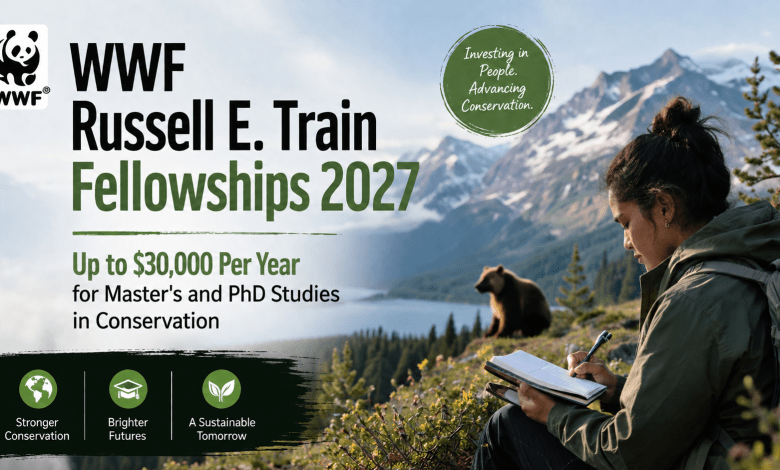
Aspiring conservation leaders and researchers from Africa, Asia, and Latin America can apply for the WWF Russell E. Train Fellowships, a prestigious funding programme that supports master’s and doctoral studies in conservation and related fields.
Administered through the World Wildlife Fund (WWF) Education for Nature (EFN) Program, the fellowships provide financial support to students and professionals committed to advancing conservation science, sustainable development, and community-led environmental solutions.
Successful applicants can receive up to $30,000 per year to support graduate studies and research.
The Russell E. Train Fellowships are designed to build the next generation of conservation scientists, practitioners, and leaders by supporting graduate education that addresses critical environmental challenges.
Through the programme, WWF invests in individuals whose research contributes to biodiversity conservation while strengthening partnerships with Indigenous Peoples and local communities.
The fellowship encourages collaborative, place-based conservation that values traditional knowledge alongside scientific research.
WWF Conservation Futures Fellowship
One of the flagship opportunities under the programme is the WWF Conservation Futures Fellowship.
The fellowship supports individuals pursuing master’s or PhD degrees focused on research that:
- Advances conservation science.
- Strengthens community-led conservation.
- Supports Indigenous Peoples and local communities.
- Promotes sustainable natural resource management.
- Encourages knowledge co-creation between researchers and communities.
- Develops practical conservation solutions based on local contexts.
Participants also become part of WWF’s growing international network of conservation professionals and environmental leaders.
Fellowship Benefits
Selected fellows may receive funding for:
- Tuition and university fees.
- Living expenses.
- Books and study materials.
- Fieldwork and research costs.
- Other approved academic expenses.
Funding levels include:
- Up to $30,000 per year for master’s and PhD students.
- Support for up to two years for master’s programmes.
- Support for up to three years for PhD programmes.
Final award amounts are determined based on the applicant’s research proposal and budget.
Eligible Countries
Applicants must be nationals of one of WWF-US’s priority countries.
Eligible countries include:
- Belize
- Bhutan
- Bolivia
- Brazil
- Cambodia
- Cameroon
- Central African Republic
- Chile
- Colombia
- Democratic Republic of the Congo
- Ecuador
- Fiji
- French Guiana
- Gabon
- Guatemala
- Guyana
- Honduras
- Indonesia
- Kenya
- Laos
- Madagascar
- Malaysia
- Mozambique
- Myanmar
- Namibia
- Nepal
- Paraguay
- Peru
- Republic of the Congo
- Suriname
- Tanzania
- Uganda
- Vietnam
- Zambia
Applicants must already be enrolled in, admitted to, or planning to enrol in an eligible master’s or PhD programme.
Who Should Apply?
The fellowship is intended for aspiring and experienced:
- Conservation scientists
- Environmental researchers
- Practitioners
- Community leaders
- Natural resource managers
- Graduate students
Successful applicants should demonstrate a strong commitment to conservation leadership and collaborative research that benefits both biodiversity and local communities.
Special Fellowship for Uganda
WWF also offers a dedicated fellowship aimed at strengthening conservation science capacity in Uganda.
The programme supports master’s research addressing human-wildlife conflict, particularly solutions to human-elephant conflict around the northern border of Murchison Falls National Park.
Eligible applicants must:
- Be Ugandan nationals.
- Hold a bachelor’s degree in a relevant discipline such as biology, ecology, conservation, zoology, or geography.
- Be enrolled in, admitted to, or have applied for a master’s programme at an accredited institution in Uganda.
Successful candidates may receive:
- Funding of up to $15,000 per year.
- Support for up to two years.
- Coverage for tuition, research, living expenses, and study materials.
The fellowship aims to develop practical, interdisciplinary approaches to promoting coexistence between wildlife and local communities.
Application Timeline
For the most recent funding cycle:
- Application deadline: 15 April 2026
- Notification of successful applicants: July 2026
Prospective applicants interested in future fellowship rounds should monitor WWF’s Education for Nature (EFN) programme announcements for updated application dates and eligibility requirements.
Why Apply?
The WWF Russell E. Train Fellowships provide more than financial support. Fellows join a global network of conservation professionals dedicated to protecting biodiversity while promoting sustainable livelihoods and community participation.
The programme places particular emphasis on:
- Conservation leadership
- Indigenous and local knowledge
- Evidence-based environmental management
- Community partnerships
- Long-term conservation impact
For graduate students and professionals seeking to build careers in conservation science and environmental leadership, the Russell E. Train Fellowships offer an outstanding opportunity to gain advanced education while contributing to solutions for some of the world’s most pressing environmental challenges.