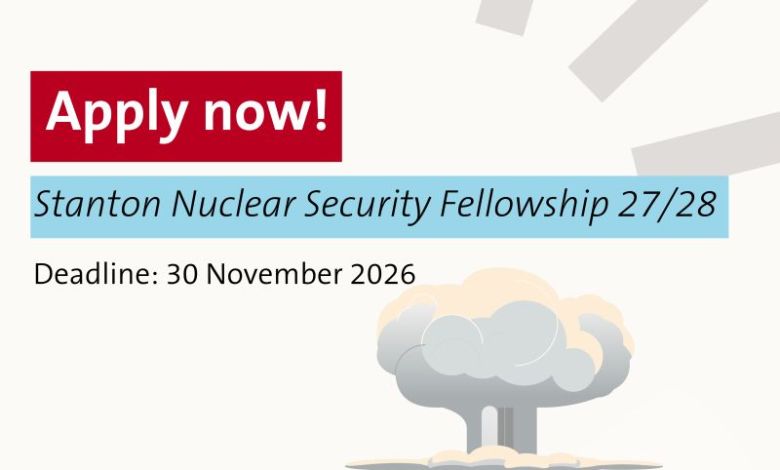
The Stanton Nuclear Security Fellows Program 2027/2028 invites applications from qualified candidates interested in advancing research and policy discussions on nuclear security. Funded by the Stanton Foundation and hosted by the Hertie School’s Centre for International Security in Berlin, Germany, the programme supports the development of the next generation of thought leaders working on nuclear security challenges.
The fellowship provides an opportunity for researchers to undertake independent, interdisciplinary research that contributes to a stronger understanding of nuclear security issues and informs relevant policy debates. Successful applicants will spend one year conducting research at the Hertie School, engaging with an academic environment focused on international security and public policy.
The application deadline is 30 November 2026.
Overview of the Stanton Nuclear Security Fellowship
The Stanton Nuclear Security Fellows Program aims to strengthen the expertise of emerging scholars and thought leaders in nuclear security. Through support for independent research, the programme encourages fellows to explore complex security challenges and produce findings that can inform policymakers, researchers and other stakeholders.
The fellowship runs for one year, beginning in September 2027, for the 2027/2028 academic year. Fellows will be based at the Hertie School’s Centre for International Security in Berlin, where they can pursue research in an environment dedicated to examining contemporary international security concerns.
The programme is particularly relevant to researchers seeking to contribute to policy-oriented discussions about nuclear risks, international security and the challenges associated with preventing nuclear threats.
Fellowship Location and Duration
The fellowship will be hosted in Berlin, Germany, at the Hertie School’s Centre for International Security.
- Programme: Stanton Nuclear Security Fellows Program
- Academic year: 2027/2028
- Duration: One year
- Research commencement: September 2027
- Host institution: Hertie School
- Host centre: Centre for International Security
- Funding organisation: Stanton Foundation
- Application deadline: 30 November 2026
- Number of awards: Up to two fellowships annually
Applicants should note that the programme involves a year-long research period based in Berlin. The official announcement does not specify whether remote participation is available.
Eligibility and Research Focus
The fellowship is designed to support the next generation of thought leaders in nuclear security. Applicants should therefore demonstrate a strong interest in nuclear security research and the potential to contribute to policy-relevant understanding of the field.
The programme emphasises interdisciplinary research, making the quality, relevance and potential impact of a proposed research project important considerations for applicants.
However, the published announcement does not provide detailed eligibility requirements concerning nationality, age, academic qualifications, professional experience or specific degree disciplines. Prospective applicants should consult the official Hertie School application page to confirm the full eligibility criteria before applying.
Stipend and Fellowship Benefits
The Stanton Nuclear Security Fellowship offers selected researchers an opportunity to dedicate a year to independent research at a recognised institution specialising in public policy and international affairs.
Key potential benefits include:
- Dedicated time to undertake independent nuclear security research.
- An academic base at the Hertie School’s Centre for International Security.
- Opportunities to develop policy-relevant research and contribute to discussions on international security.
- Professional development through engagement with an institution focused on security policy.
Stipend information: The available announcement does not specify the stipend amount, salary, travel allowance, accommodation support or other financial benefits. Applicants should verify the funding arrangements directly with the Hertie School before making financial or relocation commitments.
Application Requirements
Applicants must prepare and submit the documents specified by the programme. The required application materials are:
- Current curriculum vitae (CV): A clear summary of academic qualifications, research experience, publications and relevant professional achievements.
- Two letters of recommendation: References that can assess the applicant’s research capabilities, academic strengths and potential contribution to nuclear security.
- Personal statement: An explanation of the applicant’s research interests, motivation and suitability for the fellowship.
- Project proposal: A focused research plan outlining the proposed topic, objectives, methodology, relevance and expected contribution to nuclear security discussions.
Applicants may also be asked to provide official undergraduate and graduate academic transcripts from every institution attended since completing high school.
How to Submit an Application
Applications must be submitted exclusively through the official application button on the Hertie School’s Stanton Nuclear Security Fellows Program webpage. Applications submitted through other methods will not be accepted.
Interested candidates should follow these steps:
- Review the official fellowship announcement and confirm the complete eligibility requirements.
- Develop a focused, feasible and policy-relevant nuclear security research proposal.
- Prepare the CV, personal statement and supporting academic information.
- Arrange two suitable letters of recommendation.
- Submit the complete application through the official online application system before the deadline.
Application deadline: 30 November 2026.
For enquiries, applicants can contact the programme team at stanton@hertie-school.org.
Selection Process
The programme awards up to two fellowships each year. Applications are assessed by a selection committee comprising Hertie School faculty members and distinguished external experts in nuclear security.
According to the official announcement, selection decisions will be made by February. Applicants should ensure that their proposals clearly demonstrate intellectual merit, interdisciplinary relevance and the potential to contribute to policy discussions on nuclear security.
How to Strengthen an Application
Applicants can strengthen their submissions by identifying a specific nuclear security challenge and explaining why it deserves further investigation. A strong proposal should establish a clear research question, demonstrate familiarity with relevant scholarship, outline a credible methodology and explain how the findings could inform policy or practice.
The personal statement should complement the proposal by explaining the applicant’s motivation, relevant experience and long-term research objectives. Recommendation letters should ideally come from individuals familiar with the applicant’s academic or professional work.
About the Stanton Foundation and Hertie School
The Stanton Foundation was established by Frank Stanton, the former president of CBS, who contributed to discussions on preparedness for nuclear attack after being appointed by US President Dwight Eisenhower to a committee in 1954.
Through its support for the Nuclear Security Fellows Program, the foundation continues efforts to address nuclear security challenges by encouraging research and developing future thought leaders.
The Hertie School, located at Friedrichstraße 180, 10117 Berlin, Germany, is the host institution for the programme.
Official Application Website
Interested candidates should visit the official Hertie School website to review the complete fellowship details and access the online application system.