
A polished scholarship announcement can still be fraudulent. To avoid scholarship scams, verify the offer with its original sponsor before sharing documents, paying money, or trusting a deadline that leaves no time to check the details.
It’s reasonable to be cautious. Scammers can imitate universities and scholarship providers, while legitimate opportunities may have detailed eligibility rules and firm application dates. A familiar logo or urgent message isn’t proof either way. Requests for payment to apply for or receive a scholarship are a serious warning sign. Checking the sponsor and funding terms can help you assess the offer without dismissing a genuine opportunity.
This checklist shows you how to confirm the sponsor, eligibility requirements, award conditions, deadline, and application channel at the source. You’ll also learn what to do if you’ve already sent money or personal information. Opportunity For Africa publishes verified opportunities, including scholarships. Applicants should still confirm each offer’s details with the original sponsor before proceeding.
Key Takeaways
- Recognise guaranteed awards, unexplained payment requests, and pressure tactics as reasons to investigate, not proof on their own.
- Compare the sponsor’s identity, original announcement, eligibility rules, award terms, and application channel for consistency.
- Use contact details you find independently to verify important claims, rather than relying only on the information in the offer message.
- Learn how to avoid scholarship scams while keeping legitimate opportunities in consideration through careful source checks.
- If you’ve shared money or information, preserve relevant records and take steps suited to what was disclosed.
Avoid scholarship scams by recognising the most common warning signs
A scholarship scam misrepresents an opportunity to obtain money, personal data, account access, or another benefit. To avoid scholarship scams, treat urgent payment demands, guaranteed awards, and pressure to act as reasons to pause and investigate. Each is a warning sign, not a verdict. Legitimate opportunities can have firm deadlines and detailed application requirements, so assess the evidence before deciding.
Look beyond the presentation. A copied logo, polished website, confident testimonials, or an email that appears to come from a university can create a convincing impression without proving the sponsor’s identity. Check whether the named organisation actually announced the award and whether the claims match information published through its own channels.
- Payment before an award is released: A request for an application, processing, administration, disbursement, or redemption fee deserves particular scrutiny. The FTC identifies requests to pay money to apply for or receive scholarship funds as a warning sign.
- Guaranteed selection: A promise of an award without clear eligibility criteria or a credible selection process is a reason to verify the claim.
- Pressure or secrecy: A demand to act immediately or keep the offer confidential may be designed to prevent you from checking independently.
What scholarship scam messages often promise
Some messages arrive unsolicited and say you’ve already won a scholarship, even though you never applied. Others claim funds are waiting but can only be released after you pay a fee. These requests follow the basic pattern of advance-fee fraud schemes: the recipient is asked to give something of value first in exchange for a promised benefit later.
Legitimate sponsors should be able to explain how applicants qualify, how recipients are selected, and what the award covers. A message that promises guaranteed selection but gives no transparent process leaves a central question unanswered: what evidence supports the promise? Don’t treat confident wording as a substitute for clear, consistent terms.
How impersonation and pressure can mislead applicants
Scammers can copy institutional names, logos, staff details, and visual branding to make a message look connected to a university, foundation, or government office. They may also use a lookalike email address or website. Urgent deadlines and instructions not to discuss the offer with others can discourage careful checks, especially when an applicant fears losing a valuable opportunity.
A warning sign is a prompt to verify, not independent proof that an offer is fraudulent. A legitimate deadline may be real, but pressure to skip basic checks is not evidence of sponsorship. Pause before paying or sending documents, then compare the offer’s details with information available directly from the organisation named as sponsor.
How scholarship scams work, and what a legitimate offer should explain
A scholarship scam uses a false or impersonated opportunity to obtain money, personal information, or account access. The message may promise financial support, but the request attached to it can serve a different purpose: collecting payment, harvesting identity details, or gaining access to student records. Understanding what the sponsor is offering and what it asks you to do helps you distinguish a genuine application requirement from a demand that doesn’t fit the stated process.
Not every payment connected to education is automatically proof of fraud. A paid service, a loan, and a scholarship are different arrangements, and each should be described accurately. A scholarship is an award under stated terms; a loan involves repayment; and a paid service charges for a service rather than providing scholarship funding. Don’t let a message blur those categories. Federal Student Aid’s scam prevention guidance also warns applicants about offers that seek payment or sensitive credentials under the appearance of helping with aid.
Upfront fees, guaranteed awards, and false disbursement claims
A request to pay before a promised award is released deserves independent scrutiny, especially if payment is presented as a condition of receiving guaranteed funds. Scholarship sponsors generally explain application requirements as part of the selection process. A demand to send money to unlock an award is different from a clearly described submission step. Check who receives the payment, what it covers, and whether the sponsor’s own information describes it. Don’t assume that a label such as “processing” makes the request legitimate.
Be precise about what the offer is. If funds must be repaid, it’s a loan, not a scholarship. If a fee buys a separate service, that service should not be presented as the scholarship itself. Claims that an award is guaranteed while the selection method remains unexplained are a reason to pause and verify, not a reason to rely on the promise.
What transparent scholarship terms look like
A credible announcement should make its core terms traceable to the awarding organisation. Find the sponsor’s official website independently, then look for an announcement or programme page that matches the message. A directory listing can help you discover an opportunity, but the sponsor’s own published information is the reference point for confirming current details.
- Sponsor: The organisation awarding the funds is identified clearly.
- Eligibility: Applicant qualifications and any restrictions are stated.
- Award terms: The announcement explains what the funding covers and how it is provided.
- Selection and timing: Criteria, application steps, and deadlines are available.
Missing details, inconsistent organisation names, or unclear funding terms don’t prove fraud by themselves. They do mean you should hold off on payment or document sharing until you resolve the discrepancy. Check scholarship claims through a sponsor-controlled channel. A message’s appearance is not a substitute for confirmation from the organisation responsible for the award.
Use opportunity listings as a starting point for research, then compare each offer with the sponsor’s original terms. Scholarship opportunities for Africans can help you discover options to assess with the same care.
Legitimate scholarship or scam? Compare evidence, not appearances
Assess the offer as a trail of evidence, not a design exercise. A professional website, HTTPS connection, copied institutional logo, or active social media page can make an announcement look credible, but none proves that the named organisation is awarding funds. To avoid scholarship scams without rejecting genuine opportunities, compare the offer’s key details with information published or confirmed through the sponsor’s own channels.
Use this table to identify what you can verify and when to pause for more evidence. One mismatch may have an innocent explanation, such as an outdated repost, but don’t submit sensitive details or pay while important discrepancies remain unresolved.
| Evidence to compare | Stronger evidence | Pause and investigate |
|---|---|---|
| Sponsor identity | The organisation awarding the scholarship is named consistently, and its official site or communications confirm its role. | The message uses an unfamiliar organisation name, conflicting sponsor names, or contact details that don’t match the organisation’s own channels. |
| Original announcement | The opportunity appears on the sponsor’s website or an official channel, with details that match the message you received. | You can find only forwarded messages, reposts, or promotional pages, with no corresponding announcement from the sponsor. |
| Eligibility | Applicant qualifications and restrictions are stated clearly and align across the announcement and application materials. | Requirements change between pages, or the message claims you qualify without explaining the basis. |
| Award terms | The sponsor explains what the award covers and how selection and distribution work. | The funding promise is vague, or payment instructions appear that aren’t explained in the sponsor’s published terms. |
| Application channel | Application instructions lead to a channel identified by the sponsor through its own information. | You’re asked to use a mismatched domain, a new payment account, or a private channel that bypasses the stated process. |
Evidence that strengthens an offer’s credibility
Start with the sponsor’s official website or a communication channel you locate independently, rather than using a link in the message as your only route. Search for the exact scholarship name and compare the sponsor’s name, eligibility, award coverage, selection criteria, deadline, and application instructions. Consistency across the original announcement and related materials strengthens the evidence. Confirm any material changes directly with the sponsor.
Signals that call for a pause and further checks
A domain that differs subtly from the organisation’s usual one, changed payment instructions, or conflicting sponsor identities should prompt closer review. Be careful with requests for identity documents, financial details, or login credentials before you establish who will receive them and why. HTTPS only indicates an encrypted connection; it doesn’t certify the operator or the scholarship. Social media engagement and testimonials are similarly limited evidence.
An unfamiliar sponsor isn’t automatically fraudulent, and an established name isn’t proof that a particular message came from it. Follow the full evidence trail: confirm the source, compare material terms, and verify inconsistencies through independently located sponsor contact information. Make your decision based on those checks together, not on a single reassuring or suspicious signal.
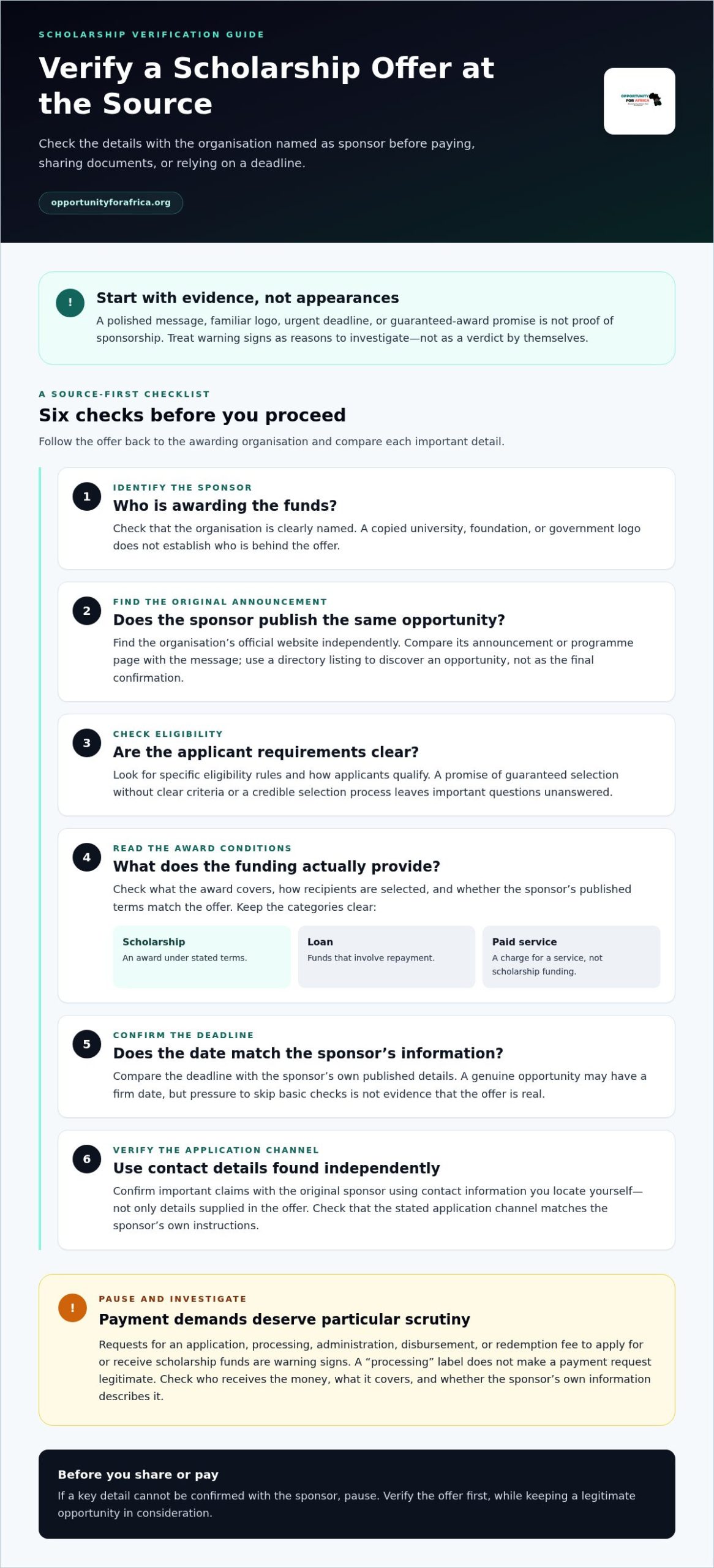
Use this scholarship verification checklist before applying or sharing documents
Follow the same source-first process for every scholarship, even when the announcement arrives through a familiar institution or a trusted opportunity directory. A careful review helps you avoid scholarship scams while keeping legitimate opportunities in consideration. Don’t pay or send sensitive documents while the sponsor’s identity or the award terms remain unclear.
Verify the sponsor and the original opportunity announcement
- Identify the awarding organisation. Record its full name and distinguish the sponsor from any school, agent, or platform sharing the listing. Confirm which organisation is responsible for selecting recipients and providing the award.
- Locate the announcement independently. Search for the opportunity on the organisation’s official website or another communication channel you reach without relying only on the message’s link. Check whether the same scholarship is currently open.
- Compare every material term. Match the sponsor name, eligibility criteria, award coverage, deadline, selection process, and application instructions. Note small differences as well as major ones. A changed deadline or alternate application address can affect where your information goes.
- Contact the sponsor through independently found details. Use contact information published on the organisation’s official site, not only an address or phone number included in the offer. Ask about specific discrepancies and wait for clarification before proceeding.
- Decide what is appropriate to submit. Provide only information required at that stage of a clearly identified application. If the process requests payment or sensitive documents before you can establish who is collecting them, pause and verify first.
A deadline doesn’t remove the need to check. If a sponsor can’t be reached before the stated closing date, it’s safer to delay sharing sensitive information than to rely on an unverified message. Keep a record of the announcement, related messages, payment requests, and any documents submitted. These records can help you compare claims, ask precise questions, or explain what happened if concerns arise.
Keep a reusable checklist
Save this short review and complete it before each application. If any answer is unclear, return to the sponsor’s official information or contact the organisation independently.
- Can I identify the organisation awarding the scholarship?
- Have I found the original announcement through an independent route?
- Do eligibility, award coverage, selection details, deadline, and application instructions match?
- Have I confirmed unexplained changes with the sponsor using independently located contact details?
- Am I sharing only information needed for this stage of the application?
Use scholarship listings as a discovery starting point, then verify each opportunity’s current terms with its original sponsor. Explore scholarship opportunities for Africans and apply this checklist before submitting an application.
What to do if a scholarship offer seems fraudulent
Act promptly, but don’t panic. Stop replying, don’t send further money or documents, and save the messages and records before blocking the sender. If you’ve already shared something, respond according to what was exposed. A payment, identity document, password, and ordinary contact detail each call for different next steps.
If you paid or shared personal information
Contact the bank, payment service, or other provider involved as soon as possible and explain what happened. Ask what steps are available; options and outcomes vary by payment method. Keep transaction details and any messages requesting payment. If you deposited a cheque and were asked to return part of the money, contact your bank before spending or sending any of those funds.
- Payment details: Ask your financial institution or payment provider to secure the account and explain what action it can take.
- Identity documents or financial information: Contact the relevant national identity, consumer-protection, or financial authority for guidance on monitoring or protecting the information you disclosed.
- Account credentials: Change exposed passwords immediately, starting with the affected account. Change reused passwords elsewhere and secure related accounts.
- Ordinary contact details: Be alert for follow-up messages that use your name or information to appear credible. Don’t respond with more personal details.
Keep copies of the original announcement, emails, direct messages, payment instructions, receipts, and documents you sent. Record dates and account names while the details are available. Don’t delete the conversation before saving relevant evidence, even if you want to block the sender.
Report the offer and continue searching carefully
Report the message to the platform where it arrived and to the official consumer-protection, cybercrime, or law-enforcement channel in your country. If the sender impersonated a university or scholarship sponsor, notify that organisation using contact details found independently. In the United States, reports involving identity theft can be made through IdentityTheft.gov, while suspected online fraud can be reported to the FBI’s Internet Crime Complaint Center. Choose the appropriate national channel for your location and circumstances.
Describe what happened factually: include the sender’s details, the offer, what was requested, and any payment or information you provided. Avoid reposting accusations you can’t substantiate. A precise report helps the relevant organisation assess the message and its evidence.
A suspicious offer doesn’t mean you need to stop looking for funding. Opportunity For Africa provides scholarship listings as a discovery resource. Independently verify each opportunity’s terms with its original sponsor before applying or sharing documents. Explore scholarship opportunities for Africans and continue your search with a careful source check.
Move forward with confidence in your next opportunity
Careful verification shouldn’t close the door on scholarship opportunities. It gives you a stronger basis for deciding where to apply, what information to share, and when to pause for clarification. Keep exploring while making source-checking part of each application, not an obstacle to your goals.
Opportunity For Africa publishes verified opportunities for Africans, including scholarships and other educational opportunities. Treat listings as a starting point for discovery, then confirm the current terms with the original sponsor. That balanced approach can help you avoid scholarship scams while staying open to genuine pathways for academic and professional growth.
Explore verified opportunities for Africans and take your next step with care. A thoughtful application begins with a credible opportunity, and your ambitions remain worth pursuing.
Frequently Asked Questions
Can a legitimate scholarship charge an application fee?
No. A legitimate scholarship sponsor shouldn’t charge you to apply for, receive, process, or claim an award. If a message asks for an “administration” or “release” payment, don’t pay until you’ve independently confirmed the terms with the sponsor. A charge for a separate service is different from a scholarship fee, so check exactly what the payment is for and who receives it.
Is a scholarship offer legitimate if it uses a university’s logo?
Not necessarily. Logos and university names can be copied into messages, social posts, and lookalike web pages. Visit the university’s website by entering its known address or finding it through an independent search, then look for the same award or ask its financial aid office using contact details published there. A logo is a visual element, not confirmation that the university issued the offer.
What should I do if I already paid a scholarship scam?
Contact the bank, card issuer, or payment service you used as soon as possible and ask what steps may be available; options depend on the payment method and circumstances. Don’t send more money, even if the sender promises a refund after another payment. Save receipts and messages. If you shared account credentials too, change the affected passwords and any reused passwords, then secure related accounts.
Should I send my passport or academic documents before a scholarship decision?
Only submit documents through an application channel you’ve verified belongs to the sponsor, and only when the application process explains why they’re needed. Some legitimate programmes may request identity or academic records during application review, so timing alone doesn’t establish fraud. If a message asks for a passport scan through a personal email or chat before you can verify the sponsor, pause and confirm the request independently.
Can scholarship scammers use social media to advertise real-looking opportunities?
Yes. A post, direct message, or account can imitate a scholarship sponsor or share an offer that appears professionally presented. Likes, comments, follower counts, and testimonials don’t establish who controls the account or whether the sponsor approved the announcement. Search the named organisation’s own website or verified communication channels for the opportunity, and avoid sharing personal documents in a social-media conversation until you confirm the application route.
Where should I report a suspected scholarship scam?
Report it to the platform where you saw the offer and to the relevant consumer-protection or cybercrime authority in your country. In the United States, use the FTC’s ReportFraud.ftc.gov for fraud, IdentityTheft.gov if personal information was misused, or the FBI’s IC3.gov for internet-enabled fraud. If a university or sponsor was impersonated, notify it through contact details you find independently. Keep copies of the messages and payment records.
What if a scholarship deadline is very close?
Check the deadline on the sponsor’s original announcement rather than relying on a countdown or urgent message. If the deadline is genuine, use the time to verify the application channel and required materials. Don’t let urgency push you into paying or sending documents to an unconfirmed recipient. If you can’t resolve a key discrepancy before the deadline, protect your information and wait for confirmation rather than bypassing the checks.