

A verified listing is a useful starting point, not a promise of admission, funding, or selection. For Africans weighing scholarships, conferences, training, or research pathways, verified opportunities for Africans can make discovery more reliable, but each opportunity still needs to match your goals and eligibility.
It’s reasonable to be cautious: a listing can help you find an opportunity, but it can’t determine whether you qualify or replace the host institution’s official terms. Opportunity For Africa shares verified listings across academic and professional development categories, giving you a place to begin your search without treating discovery as approval.
This guide explains what verification can and can’t tell you, how to compare eligibility, funding coverage, format, and deadlines, and how to assess fit before investing time in an application. You’ll also learn how to use listing details as a screening tool, confirm key requirements through the official host, and choose an informed next step.
Key Takeaways
- Use verified opportunities for Africans as a discovery resource, then rely on the official provider’s terms to determine eligibility and application outcomes.
- Compare formats by stage: degree study and research pathways serve different goals from short courses, training, and conferences.
- Screen each listing in order: applicant eligibility, purpose, funding coverage, deadline, and official application source.
- Prioritize fit with your profile and goals before weighing prestige, destination, or funding language.
- Start with a relevant category, review a listing, assess your fit, and follow the host’s official instructions for your next step.
What “verified opportunities for Africans” means, and what it does not guarantee
Verification helps readers discover and assess an opportunity; it does not assure an application outcome. Opportunity For Africa describes its listings as verified, but that does not replace the opportunity provider’s current rules. Eligibility, application conditions, and final decisions belong to the organization offering the opportunity.
A verified opportunity is a starting point for discovery, not a promise of eligibility, funding, admission, employment, or selection.
What a verified listing can help you establish
A listing can summarize an opportunity and point you toward its details, helping you decide whether it merits closer review. Where information is provided, eligibility, format, funding coverage, and deadlines can help you screen options before preparing an application. Treat these details as a guide to the provider’s terms, not a replacement for them.
For example, a listing may identify whether an opportunity is a course, conference, degree programme, or research pathway. It may also describe funding or give an application deadline. These details help you compare the opportunity with your needs, while the official announcement remains the reference for what is covered and which dates apply.
- Eligibility: Note the stated applicant group and any country, career-stage, or qualification criteria.
- Format: Identify whether the opportunity involves study, training, research, or conference participation.
- Coverage and timing: Distinguish funding information from other benefits, and confirm the stated deadline with the provider.
Clear summaries can also help readers pause before sharing sensitive information or responding to suspicious requests. For background on employment and application scams, review common warning signs, then assess an opportunity through the official source provided by its host.
What verification cannot decide for an applicant
A listing cannot determine whether your individual circumstances satisfy the official rules. Eligibility for Africans may depend on a specified country or residence status, as well as academic qualifications, professional experience, or career stage. Read the complete eligibility terms rather than relying on a broad description of an opportunity as open to Africans.
Verification also cannot promise selection or establish that every applicant will receive financial support. A scholarship listing is not the scholarship provider, admissions office, or funder. Funding may have defined limits, conditions, or exclusions, so confirm the exact coverage with the responsible organization before making financial or study plans.
Use the listing to identify a potentially relevant opportunity, then follow the provider’s official instructions. Compare the requirements with your profile, check the deadline and coverage in the original terms, and proceed only when the opportunity’s purpose and conditions make sense for you. This is what makes verified opportunities for Africans useful: they support informed discovery while leaving decisions and commitments with the responsible institution.
Which verified opportunities for Africans can you find?
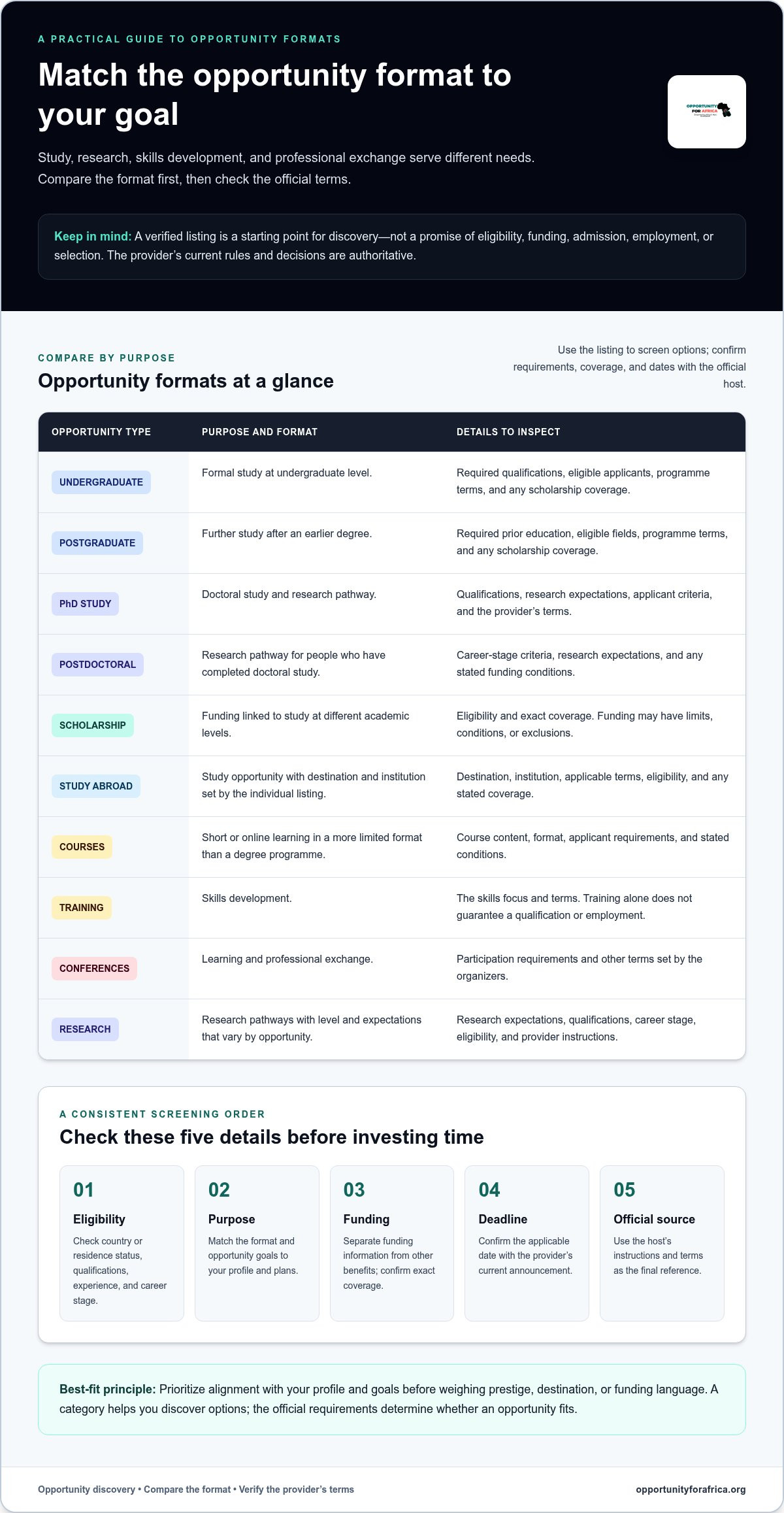
Opportunity For Africa brings together opportunities across study, research, skills development, and professional exchange. The categories serve different needs: a degree pathway may suit someone seeking a formal academic qualification, while a short course or conference may better match a focused learning or networking goal. A category is a starting point, not a signal that every listing fits every applicant.
Study, scholarship, and research opportunities
Study listings include undergraduate, postgraduate, and PhD opportunities, each intended for a different academic stage. Postdoctoral opportunities are research pathways for people who have completed doctoral study. Scholarship listings may relate to study at any of these levels, but eligibility and coverage vary by opportunity. Listings may also feature study abroad options; the destination, institution, and applicable terms depend on the individual opportunity.
Keep the stages distinct as you browse. An undergraduate opportunity is not interchangeable with a master’s or other postgraduate programme, and doctoral or postdoctoral research has its own purpose and entry requirements. Compare the level and research expectations with your current qualifications before weighing other features.
Training, courses, and conference opportunities
Short and online courses offer learning in a more limited format than a degree programme. Training may help develop skills, but it does not by itself guarantee a qualification or employment. Conferences offer opportunities for learning and professional exchange; participation requirements and other terms are set by the organizers.
Use the format to clarify your goal. If you need a formal academic award, focus on degree-study listings. If you want focused learning or professional engagement, courses, training, and conferences may be more relevant, depending on their stated content and conditions.
Opportunity category | Purpose and typical format | Details to inspect
Undergraduate study | Formal study at undergraduate level. | Required qualifications, eligible applicants, programme terms, and any scholarship coverage.
Postgraduate study | Further study after an earlier degree, including postgraduate opportunities. | Required prior education, eligible fields, funding terms, and application deadlines.
PhD opportunities | Doctoral study or research. | Academic prerequisites, research expectations, funding coverage, and provider instructions.
Postdoctoral opportunities | Research pathways after doctoral study. | Required experience, research focus, appointment terms, and eligibility.
Short and online courses | Focused learning outside a full degree pathway. | Subject, delivery format, duration, completion terms, and any stated costs or support.
Training | Skills development through a training format. | Intended participants, learning objectives, schedule, and completion details.
Conferences | Learning and professional exchange. | Participation criteria, format, dates, and organizer terms.
Use this overview to narrow your search by academic stage or professional goal, then review the terms attached to each listing. Browse the opportunity categories to find formats that align with what you want to pursue.
How to assess a verified opportunity listing before acting
Use a consistent screening sequence before investing time in an application: confirm who can apply, what the opportunity is for, what its coverage includes, when applications close, and where the official instructions are published. This helps you separate an appealing headline from the requirements that determine whether the opportunity is practical for you.
The official provider’s current terms govern an application because they define eligibility, coverage, deadlines, and the steps applicants must follow.
Read eligibility and opportunity scope precisely
Start with the eligibility rules, not the destination or funding headline. Check eligible countries and any residence conditions, then compare the required academic level, experience, qualifications, and other restrictions with your circumstances. “Open to Africans” may still refer to a defined set of countries or applicant profiles, so read the criteria rather than assuming your nationality or location automatically qualifies you.
Next, identify the opportunity’s purpose. A study programme, research placement, training course, and conference each have different aims and participation requirements. Confirm that the format suits your current stage and goal. A mismatch in purpose or one unmet eligibility criterion can make an otherwise attractive listing unsuitable.
Confirm the terms and deadline at the official source
Open the provider’s current instructions and compare them with the listing summary. Review any stated funding line by line: identify what it covers, who receives it, and what costs or requirements fall outside the described package. A headline that mentions a scholarship or funding does not establish full financial coverage.
Use this ordered checklist to make a decision:
- Applicant eligibility: Check country, residence, education level, experience, and any stated restrictions.
- Opportunity purpose: Confirm the activity, programme level, or professional goal described by the provider.
- Coverage: Record the specific expenses or support named in the official terms, and note what is not stated as covered.
- Deadline: Find the closing date and any relevant time-zone detail in the provider’s instructions.
- Official source: Confirm that the responsible institution provides the application route and required steps.
For example, someone considering postgraduate study should verify that the listed level matches their intended programme, then check whether funding applies to tuition, other expenses, or only specified components. Don’t infer coverage from a short summary. The provider’s detailed terms should explain what the funding includes.
After confirming fit, record the official deadline and next required step, such as completing an application form or submitting specified materials. Keep the source page available while you prepare, so you can refer to its instructions instead of relying on a copied summary. This process makes verified opportunities for Africans easier to assess on their actual conditions, not just their headline appeal.
How to match verified opportunities to your profile and goals
Choose opportunities by how well they fit your current stage and intended outcome, not by prestige alone. A well-known name, attractive destination, or funding headline can draw attention, but none can replace eligibility and purpose. Start with what you can demonstrate now, then compare each listing with the qualifications and goals stated by its provider.
Prioritize fit before preparing an application. This helps you reserve application time for opportunities that match both your profile and the outcome you want.
Match opportunity format to your current stage
Map your current qualifications and goals to the format. Undergraduate and postgraduate study suit different academic stages; PhD listings call for the research background and qualifications specified by the provider, while postdoctoral opportunities are intended for applicants who meet the stated research requirements. Courses, training, and conferences can support a focused learning or professional objective without replacing a degree pathway.
Your current stage or goal | Formats to consider | Fit questions
Preparing for a first degree | Undergraduate study and related scholarship opportunities. | Do you meet the entry qualifications and country criteria?
Already hold a degree | Postgraduate study or a relevant short or online course. | Does the opportunity require your current qualification, and does it serve your next academic step?
Building a doctoral research profile | PhD study or research opportunities. | Do your academic preparation and research interests align with the stated requirements?
Completed doctoral study | Postdoctoral opportunities. | Does your experience meet the provider’s qualifications and research focus?
Seeking targeted skills or professional exchange | Training, courses, or conferences. | Does the content address a specific skill, subject, or professional objective?
Set practical priorities before committing application time
For each listing, assess eligibility first, then relevance to your goal, timing, and clearly stated support. Separate mandatory qualifications from preferences when the official notice distinguishes them. A required degree or eligible-country rule is a threshold; a preferred skill may strengthen an application, but it is not compulsory unless the provider says so.
Use a short comparison note for each strong-fit option: record the requirement you meet, the goal it supports, the deadline, and the support or coverage explicitly described. If you do not meet a basic requirement, set the listing aside rather than letting a prestigious title or broad funding language outweigh the mismatch.
Keep your shortlist manageable. A smaller group of relevant opportunities makes it easier to follow each provider’s instructions and prepare materials suited to the stated purpose. For scholarship applications, use the provider’s instructions to guide your preparation, and return to the official notice if a requirement is unclear.
Use Opportunity For Africa listings to identify options that align with your current stage, then compare each one against your priorities before committing application time.
How to use Opportunity For Africa listings and take the next step
Use Opportunity For Africa as a discovery point, then move from a relevant listing to the organization responsible for the opportunity. This helps you compare options without assuming that a category or headline means an opportunity is open, suitable, or guaranteed. The platform’s categories include scholarships, undergraduate and postgraduate study, PhD and postdoctoral opportunities, research, short and online courses, training, and conferences.
Navigate by opportunity type and review the listing
Begin with the category that matches your immediate goal. If you’re seeking a degree pathway, focus on the relevant study level; for targeted learning, consider courses or training; for professional exchange, review conference listings. Then read the individual summary for its intended applicant group, purpose, and stated timing.
- Choose a category that reflects your study stage or professional objective.
- Open a relevant listing and note the applicant group, opportunity format, and stated dates.
- Assess your fit against the requirements and your circumstances before preparing materials.
- Consult the official instructions issued by the provider for complete eligibility, coverage, deadlines, and application or participation steps.
This order keeps discovery and decision-making distinct. A short summary can help you decide whether to investigate further, but it may not include every condition or explain each stage of the process. Use it to identify what deserves your attention, not as the final authority on the terms.
Move from discovery to a deliberate next step
Once you’ve found a potentially relevant option, compare the listing with the provider’s current instructions. Confirm that you meet the stated criteria, understand any listed support or coverage, and can complete the required steps by the official deadline. The provider sets the application or participation process and makes decisions about eligibility and outcomes.
If the opportunity fits, follow the provider’s stated process rather than relying on assumptions from a headline or summary. Keep the official instructions and deadline together with your planning notes. This makes it easier to track requirements, identify materials you need, and return to the authoritative source as you prepare.
If the requirements don’t match your profile or goals, set that listing aside and review another category. This is a practical part of the search, not a setback: verified opportunities for Africans cover different study and career stages, and selecting for relevance helps focus your effort on options worth pursuing.
Explore Opportunity For Africa’s verified listings to find categories that align with your next academic or professional step, then use each listing as a starting point for reviewing the provider’s official terms.
Turn your search into a clear next step
Opportunity searching works best when it supports a direction you’ve chosen, rather than becoming a race to apply for every attractive listing. Identify the study or career milestone you want to reach next. That goal can help you decide which possibilities deserve attention and which can wait.
Keep your approach flexible. A suitable opportunity may take time to find, and a listing that isn’t right for you now may clarify what qualifications or experience to build toward. Make each decision with the provider’s requirements in view, and treat verified opportunities for Africans as a starting point for informed choices, not a measure of your potential.
Take the next step at a pace that lets you review options carefully. Explore verified opportunities for Africans and look for a pathway that aligns with what you want to pursue. With a clear goal and close attention to the terms, you can move forward with greater confidence.
Frequently Asked Questions
Are all opportunities for Africans fully funded?
No. Funding depends on the individual opportunity and its official terms. Some listings describe scholarships or other funded programmes, while courses, conferences, training, or research opportunities may offer different support or none. Open the provider’s notice and identify whether support covers tuition, travel, accommodation, materials, or only a defined component. Check who can receive it and whether separate expenses remain your responsibility. A funding label alone doesn’t establish full coverage.
Can Africans apply for international opportunities listed online?
Some international opportunities accept applicants from African countries, but access depends on each programme’s rules. A notice may specify eligible countries, require applicants to live in a particular country, or set academic and professional criteria. Check those conditions against your circumstances before gathering documents. A listing intended for Africans doesn’t automatically mean every African applicant qualifies, so use the provider’s published criteria to decide whether to proceed.
Does a verified opportunity guarantee that I will be selected?
No. A verified listing can help you discover an opportunity, but it doesn’t guarantee eligibility, admission, funding, employment, or selection. The provider assesses applications using its own criteria and process. Before applying, review the required materials and submit them through the channel specified in the official notice. Even a complete application may not result in selection; the provider makes that decision, so plan accordingly.
Do verified opportunities include scholarships, courses, and conferences?
Yes. Opportunity For Africa lists scholarships, undergraduate and postgraduate study, PhD and postdoctoral opportunities, courses, training, and conferences. These options serve different purposes: a course may focus on a defined subject, while a conference centres on participation and exchange. Requirements and arrangements differ by listing. Choose a category that fits your current goal, then examine the provider’s terms to understand the format and application or participation process.
Who sets the eligibility rules for an opportunity listing?
The organization offering the opportunity sets its eligibility rules, application process, and terms. A listing helps you find and review an announcement, but the provider’s official information governs. Check the notice for required qualifications, eligible countries, supporting documents, and submission instructions. If you saved or copied details earlier, compare them with the provider’s current published notice before acting, especially if the application period or instructions have changed.
Can I apply directly through Opportunity For Africa?
Opportunity For Africa is an information platform that shares listings; it isn’t the scholarship funder, course provider, or admissions office for the opportunities described. Each opportunity’s provider determines how to apply or participate. Open the official instructions linked or named in the announcement to find the correct application channel, required materials, and deadline. Follow that process rather than assuming that discovering a listing completes any part of an application.