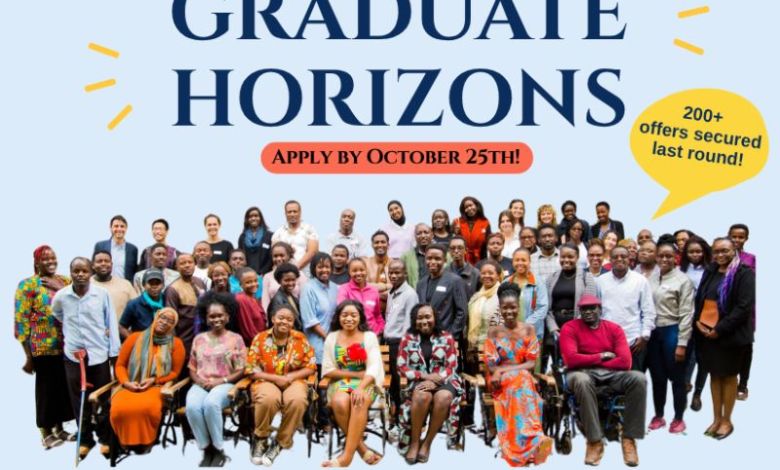
The Refugee-Led Research Hub (RLRH) is inviting applications for Graduate Horizons, a free global mentorship programme supporting prospective Master’s students affected by forced displacement to apply for funded graduate programmes beginning in 2027.
The programme is designed to help participants identify suitable Master’s degrees and scholarships, strengthen their applications and submit competitive applications with guidance from RLRH staff and mentors.
Graduate Horizons provides access to application support for more than 250 Master’s degree scholarships across 25+ universities worldwide. In the previous programme cycle, Graduate Horizons learners received more than 200 university offers.
Programme Overview
Programme: Graduate Horizons
Provider: Refugee-Led Research Hub (RLRH)
Level: Master’s degree
Target intake: 2027
Location: Online
Duration: November 2026 to April 2027
Cost: Free
Application deadline: 25 October 2026 at midnight
Eligible applicants: People affected by displacement, including applicants from Africa
Participants can be based anywhere in the world. They will be matched with an RLRH mentor or staff member and can receive support through platforms including email, WhatsApp and Zoom.
What Does Graduate Horizons Offer?
Graduate Horizons is an application support and mentorship programme, rather than a scholarship itself. Its purpose is to help participants become stronger applicants for funded Master’s opportunities.
Over approximately six months, participants will receive structured support through group workshops, application clinics and guidance sessions, with additional individual support where needed.
The programme aims to help each participant submit at least three Master’s applications by the end of the programme.
Support includes:
- Developing an action plan for graduate admissions.
- Short courses to strengthen applicants’ profiles.
- Identifying suitable Master’s degrees and scholarships.
- Understanding application requirements.
- Preparing scholarship applications.
- Completing and submitting applications.
- Ensuring required supporting documents are prepared.
- Accessing RLRH office hours for individual questions and guidance.
Universities and Scholarship Opportunities
For this application round, Graduate Horizons will particularly support applications to universities with deadlines falling between December 2026 and April 2027.
The highlighted institutions include:
- University of Oxford, UK
- University of Cambridge, UK
- Sciences Po, France
- University of California, Berkeley, USA
- Carnegie Mellon University-Africa, Rwanda
- University of Global Health Equity, Rwanda
- Université Mohammed VI Polytechnique, Morocco
- African Institute for Mathematical Sciences (AIMS), South Africa
- American University in Cairo, Egypt
- American University of Beirut, Lebanon
These institutions are members of the Mastercard Foundation Scholars Program network. RLRH also indicates that participants interested in other universities and scholarships with upcoming deadlines can receive support.
Who Is Eligible?
Graduate Horizons is specifically designed for applicants who have been affected by displacement.
Eligible backgrounds may include current or former:
- Refugees
- Asylum seekers
- Internally displaced persons (IDPs)
- Stateless persons
- People affected by other forms of displacement or intergenerational dislocation
Applicants must also have completed, or be in the final year of, a Bachelor’s degree.
Typically, applicants should have academic results equivalent to approximately 75%, a UK 2:1 degree classification, or a 3.0 GPA out of 4.0, or the equivalent qualification in their education system.
Applicants must be capable of studying in English or French and writing to a professional standard without relying on AI.
They should also intend to submit applications to graduate programmes within the following six months for 2027 enrolment.
Who Is Particularly Encouraged to Apply?
RLRH encourages applications from groups that remain under-represented in higher education, including women, LGBTQ+ and gender non-conforming people, and persons with disabilities.
However, the programme’s displacement requirement is essential. Individuals who have not been affected by displacement are not eligible for Graduate Horizons.
Application Deadline
Applications for this round close at midnight on Sunday, 25 October 2026.
The programme is scheduled to run from the first week of November 2026 through April 2027.
The application form is expected to take approximately 1.5 to 2 hours to complete, so applicants should allow sufficient time to prepare their responses and submit the form before the deadline.
Information Sessions
RLRH is also hosting information sessions for prospective applicants. The sessions cover the same information, so applicants only need to attend one.
The scheduled sessions are:
- 8 October 2026 – 10:00 a.m. BST
- 15 October 2026 – 1:00 p.m. BST
- 22 October 2026 – 3:00 p.m. BST
Applicants unable to attend can contact the Graduate Horizons team about accessing a recording.
How to Strengthen an Application
Applicants should begin by identifying Master’s programmes that align closely with their academic background, professional goals and long-term interests. They should also research scholarship eligibility requirements and upcoming deadlines before selecting their target programmes.
A strong application should clearly explain the applicant’s academic journey, experience of displacement where relevant, future ambitions and reasons for pursuing postgraduate study.
Applicants should take advantage of the programme’s workshops and application clinics and prepare academic documents, CVs, references and personal statements well in advance.
Why Join Graduate Horizons?
Graduate Horizons can be particularly valuable for displaced African students who may have the academic qualifications to pursue postgraduate study but lack access to specialised scholarship application guidance.
The programme provides structured mentorship, practical application support and exposure to a wide range of funded Master’s opportunities. By helping participants identify suitable programmes and submit stronger applications, RLRH aims to expand access to graduate education for people affected by displacement.
About the Refugee-Led Research Hub
The Refugee-Led Research Hub (RLRH) supports people with lived experience of displacement to develop academic and professional careers in areas including human rights, forced migration, politics, law and other fields.
RLRH provides academic and professional development programmes and supports access to graduate education and advanced professional opportunities. Its network includes more than 1,400 individuals across more than 100 countries.
Applicants should verify the latest eligibility criteria, participating universities, scholarship requirements and deadlines directly with RLRH before applying.