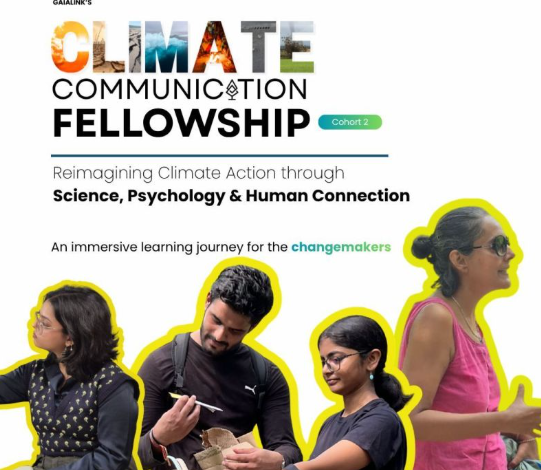
GaiaLink has opened applications for the Climate Communication Fellowship – Cohort 2, a six-week immersive development programme designed for young Indian changemakers aged 18–35 who want to strengthen their ability to communicate climate issues and inspire meaningful action.
The fellowship is built around a central question: if climate change affects everyone, why does it often feel disconnected from everyday conversations? GaiaLink’s programme seeks to address this communication gap by combining climate science, behavioural psychology, storytelling, systems thinking and practical campaign development.
Applications for Cohort 2 are open until 2 September 2026.
About the Climate Communication Fellowship
Launched in 2024, GaiaLink’s Climate Communication Fellowship was developed from insights gathered through workshops and extensive conversations on climate and sustainability. The programme recognizes that limited climate action is not necessarily caused by a lack of information. Instead, the challenge often lies in making climate issues relatable, emotionally meaningful and connected to people’s everyday experiences.
The fellowship therefore trains participants to question intentions, decode narratives, understand audience behaviour and develop communication strategies that can turn climate concern into action.
The programme is particularly suited to young professionals, students, communicators, researchers and sustainability enthusiasts who want to become more effective climate storytellers.
Fellowship Format and Duration
The Climate Communication Fellowship is delivered through a hybrid format across Delhi-NCR. Participants should expect to dedicate approximately 6–10 hours per week to the programme.
Weekday evenings feature interactive online workshops, discussions and learning sessions, while weekends include practical field experiences across Delhi-NCR. These may involve visits to urban forests, circular economy initiatives and other sustainability-focused locations.
The programme emphasizes collaboration rather than competition, allowing fellows to co-create campaigns, exchange ideas and develop relationships with peers, mentors and professionals working across the climate sector.
What Participants Will Learn
Throughout the six-week programme, fellows will develop practical and conceptual skills covering climate science, communication and behavioural change.
Key learning areas include:
• Understanding the science of climate change from both global and Indian perspectives
• Exploring the psychology and behavioural factors behind climate inaction
• Understanding cognitive biases, emotional triggers and narrative framing
• Identifying and decoding corporate greenwashing
• Examining government climate policy and India’s Nationally Determined Contributions
• Translating research into accessible and engaging content
• Developing communication strategies for different audiences and platforms
• Creating emotionally resonant climate stories and campaigns
• Designing and presenting a complete climate communication strategy
Six-Week Curriculum
The curriculum progresses from foundational knowledge to practical campaign development.
Week 1 – The Basics: Participants explore climate science and the fundamentals of climate communication, including why facts alone may not drive behavioural change.
Week 2 – India’s Climate Reality: The module examines India-specific climate impacts, regional vulnerabilities and the importance of connecting global climate issues to local realities.
Week 3 – Psychology, Behaviour & Narrative Framing: Fellows investigate cognitive biases, denial, emotional triggers and the role of narratives in influencing climate engagement.
Week 4 – Systemic Overview & Narrative Decode: Participants examine government climate policy, India’s NDC commitments and corporate greenwashing.
Week 5 – Format & Distribution: Fellows learn how to transform research into effective content, select appropriate formats and develop distribution strategies.
Week 6 – Strategy & Pitch: Participants bring their learning together by developing and presenting a complete climate communication campaign strategy.
Who Should Apply?
The fellowship welcomes young Indians aged 18–35 from diverse academic and professional backgrounds.
It is particularly relevant to students and young professionals working or studying in areas such as communication, environmental studies, climate policy, psychology, design and media.
The programme also welcomes curious individuals who want to communicate climate issues with greater empathy and clarity, as well as storytellers interested in connecting climate action with human experiences and systems thinking.
Programme Fee and Key Dates
The fellowship carries a programme fee of INR 6,999.
Important dates include:
• Applications close: 2 September 2026
• Programme induction: 5 September 2026
• Programme completion: 17 October 2026
The fellowship is a six-week intensive programme combining online learning, field visits, workshops, campaign development and networking.
Why the Fellowship Stands Out
GaiaLink describes the programme as human-first and science-rooted, combining environmental science with behavioural psychology, empathy mapping and systems thinking.
Its approach is also deeply local while maintaining a connection to broader global climate frameworks. Rather than relying solely on lectures, participants learn through workshops, field experiences, storytelling exercises and campaign design.
Fellows also become part of a growing network involving mentors, researchers, speakers and grassroots sustainability leaders.
Application Information
Interested applicants can apply for GaiaLink’s Climate Communication Fellowship Cohort 2 before the 2 September 2026 deadline. The opportunity provides participants with an intensive platform to develop climate communication skills, gain practical experience and connect with others working toward a more sustainable future.
The programme is particularly valuable for individuals who believe that effective climate action requires more than communicating scientific facts—it requires creating stories, connections and conversations that motivate people to act.
Applications can be submitted through the official GaiaLink application form.