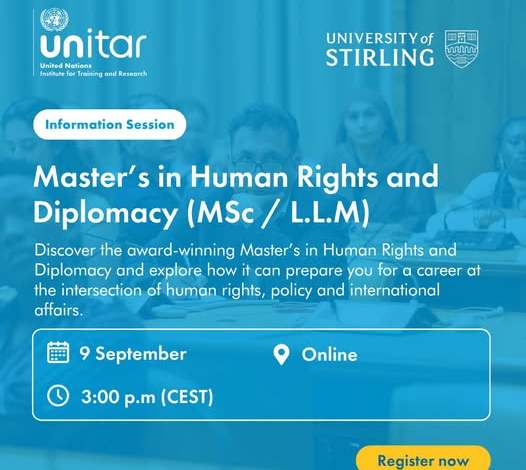
The United Nations Institute for Training and Research (UNITAR), in collaboration with the University of Stirling, is offering a Master’s programme in Human Rights and Diplomacy for graduates and professionals seeking advanced expertise in international human rights, diplomacy, international law and multilateral institutions.
The programme is available through MSc and LL.M pathways and combines academic study with practical training. It is designed to equip participants with the knowledge and professional skills needed to engage with human rights institutions, diplomatic processes, international organisations, governments and civil society.
The next programme is scheduled to begin in January 2027 and will be delivered full-time and in person at the University of Stirling in Scotland, United Kingdom.
Programme Overview
The Human Rights and Diplomacy programme provides an interdisciplinary learning experience covering the theory and practical application of human rights law and politics. Participants will explore the historical and philosophical foundations of human rights, the development of United Nations human rights institutions and the role of diplomacy in international relations.
The programme welcomes applicants from diverse academic backgrounds, including law, politics, philosophy, sociology, international relations and related disciplines.
Students will also receive practical training from experienced professionals and human rights practitioners. The programme places particular emphasis on negotiation, public speaking, leadership, advocacy, document preparation and professional engagement with human rights institutions.
Practical Learning and UN Exposure
One of the programme’s distinctive features is its focus on practical experience alongside academic study. Students will participate in exercises designed to strengthen their ability to negotiate, prepare documents and communicate effectively within human rights and diplomatic settings.
A study visit to Geneva will provide students with an opportunity to observe the United Nations, the Human Rights Council and the wider diplomatic environment. This exposure can help participants develop a stronger understanding of how international human rights institutions operate in practice.
During the final semester, students with a strong profile may also have the opportunity to apply for on-the-job training within the UN system or with UN-affiliated organisations. Other pathways include professional projects with human rights organisations or the completion of an academic dissertation.
Learning Outcomes
By completing the programme, students are expected to develop the ability to:
• Explain, analyse and apply international human rights law in theory and practice.
• Understand diplomacy, its historical development and its relationship with international relations.
• Examine and debate critiques of human rights.
• Draft professional documents and develop negotiation skills for human rights institutions.
• Understand the work of United Nations human rights institutions and relevant local NGOs.
• Apply theoretical and practical research methods to human rights research, activism and politics.
These competencies can support careers in international organisations, government, diplomacy, human rights advocacy, NGOs, research institutions and related fields.
Eligibility Requirements
Applicants must normally hold a minimum of a second-class honours degree or equivalent qualification. Candidates who do not meet the formal academic requirements but possess significant relevant professional or life experience are also encouraged to apply.
The programme accepts candidates from a broad range of disciplines. Graduates in politics, philosophy, sociology and law may apply for either the MSc or LL.M pathway, depending on their academic and professional background.
International applicants must also meet the University’s country-specific admission requirements.
English Language Requirements
Applicants whose first language is not English must provide evidence of English proficiency through an accepted qualification. Examples include:
• IELTS Indicator: 6.5 overall, with at least 6.0 in each sub-skill.
• Cambridge C1 Advanced: 176 overall, with at least 169 in each component.
• Cambridge C2 Proficiency: 180 overall, with at least 169 in each component.
• Pearson Test of English Academic: 62 overall, with at least 60 in each component.
• TOEFL iBT: 80 overall, subject to minimum component scores.
• Accepted Trinity ISE qualifications.
• Aptis: CEFR B2 overall and B2 in all sub-skills.
Applicants should consult the University of Stirling for the latest accepted qualifications and possible exemptions.
Fees and Scholarships
For the January 2027 intake, tuition fees are listed as £11,500 for students from the UK and Republic of Ireland and £24,300 for international students, including EU students.
Partial scholarships are available, and prospective students should consult the University of Stirling’s funding information for current scholarship opportunities, eligibility conditions and application procedures.
Programme Details
Programme: Human Rights and Diplomacy
Qualification: MSc or LL.M
Institution: University of Stirling, in partnership with UNITAR
Start date: January 2027
Duration: 12 months, full time
Delivery: In person
Location: Stirling, United Kingdom
International application deadline: November 2026, exact date to be confirmed
Career Opportunities
The programme is designed for graduates and professionals seeking to strengthen their expertise in human rights, international law, diplomacy, negotiation and leadership. Its interdisciplinary structure and practical orientation can be particularly relevant to individuals targeting careers with the United Nations, international organisations, government institutions, diplomatic missions, NGOs and human rights organisations.
The combination of academic instruction, practical exercises, Geneva exposure and potential professional placements provides participants with multiple pathways to develop both theoretical knowledge and workplace-ready skills.
How to Apply
Interested candidates should submit their applications through the University of Stirling’s official application system and review the institution’s current admission, funding and international student requirements before applying.
Prospective applicants are encouraged to begin preparing their academic certificates, English-language evidence and other supporting documentation well ahead of the November 2026 international application deadline.