

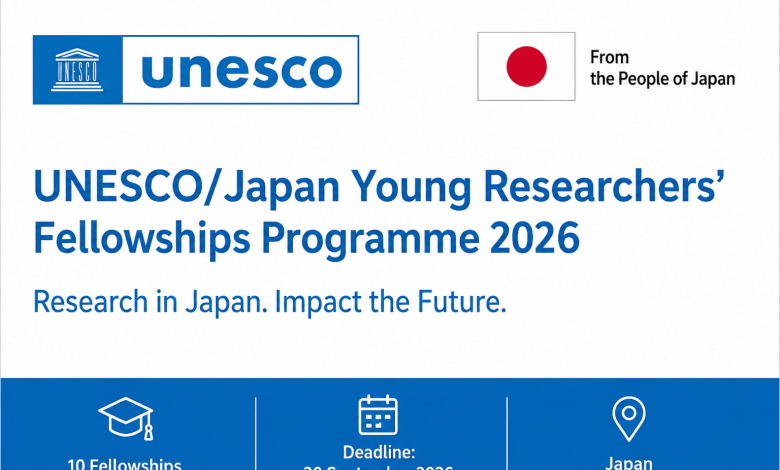
UNESCO has officially opened applications for the UNESCO/Japan Young Researchers’ Fellowships Programme 2026, also known as the UNESCO/Keizo Obuchi Research Fellowships Programme. The prestigious international fellowship offers 10 research fellowships to outstanding young researchers from eligible countries, including 47 African nations, to undertake postgraduate research at universities and research institutions in Japan.
Established through the Japanese Funds-in-Trust for the Capacity-Building of Human Resources, the programme aims to strengthen global research collaboration, promote academic excellence, and support innovative research aligned with UNESCO’s priorities. Since its launch in 2001, the initiative has supported 291 young researchers from 101 countries, helping build research capacity and advance knowledge in areas of global importance.
For the 2026 cycle, the fellowship will support research focused on heritage conservation, sustainable development, and artificial intelligence, with successful applicants undertaking research stays in Japan between February and December 2027.
The application deadline is 30 September 2026 (Midnight Paris Time).
About the UNESCO/Japan Young Researchers’ Fellowships Programme
The UNESCO/Japan Young Researchers’ Fellowships Programme was created to encourage international academic cooperation while supporting early-career researchers working on issues aligned with UNESCO’s mission.
The programme provides funding for postgraduate research conducted at Japanese universities and research institutions under the supervision of an academic host.
Successful fellows will have the opportunity to:
- Conduct advanced research in Japan.
- Collaborate with leading Japanese academics and research institutions.
- Strengthen international research networks.
- Contribute innovative solutions to global development challenges.
- Enhance their academic and professional careers through international research experience.
Fellowship Overview
The 2026 fellowship includes the following benefits:
- Number of fellowships: 10.
- Maximum fellowship grant: Up to US$10,000.
- Research duration: Between 3 and 9 months.
- Host country: Japan.
- Research period: From February 2027 and completed no later than December 2027.
- Application deadline: 30 September 2026.
Applications must be submitted through each applicant’s National Commission for UNESCO, which is responsible for nominating candidates to UNESCO.
Research Areas
Applicants must submit research proposals under one of the programme’s approved thematic areas.
Eligible research fields include:
- Heritage Conservation and Management.
- AI for Sustainable Management of Natural Resources and Climate Action.
- Ethical, Inclusive and Human-Centred Artificial Intelligence for Sustainable Development.
- AI for Sustainable Cities, Infrastructure and Societal Resilience.
- AI and Education.
Applicants are required to select one primary research area together with the corresponding sub-area that best matches their proposed research project.
The programme encourages interdisciplinary research that integrates technology, governance, ethics, sustainability, and social development.
Eligible Countries
The 2026 fellowship is open to applicants from selected UNESCO Member States and Associate Members.
Eligible African countries include:
- Angola.
- Benin.
- Botswana.
- Burkina Faso.
- Burundi.
- Cameroon.
- Cabo Verde.
- Central African Republic.
- Chad.
- Comoros.
- Congo.
- Côte d’Ivoire.
- Democratic Republic of the Congo.
- Djibouti.
- Equatorial Guinea.
- Eritrea.
- Eswatini.
- Ethiopia.
- Gabon.
- Gambia.
- Ghana.
- Guinea.
- Guinea-Bissau.
- Kenya.
- Lesotho.
- Liberia.
- Madagascar.
- Malawi.
- Mali.
- Mauritius.
- Mozambique.
- Namibia.
- Niger.
- Nigeria.
- Rwanda.
- São Tomé and Príncipe.
- Senegal.
- Seychelles.
- Sierra Leone.
- Somalia.
- South Africa.
- South Sudan.
- Togo.
- Uganda.
- United Republic of Tanzania.
- Zambia.
- Zimbabwe.
The programme also welcomes applicants from eligible countries in Asia and the Pacific, Latin America and the Caribbean, the Arab States, Türkiye, and Ukraine.
Eligibility Requirements
Applicants must satisfy all eligibility requirements before applying.
Candidates must:
- Be nationals of one of the invited Member States or Associate Members.
- Be 40 years of age or younger at the time of application.
- Hold at least a Master’s degree or an equivalent qualification relevant to the proposed research.
- Demonstrate strong academic and research potential.
- Possess sufficient proficiency in the language used by the proposed host institution in Japan.
- Obtain formal acceptance from an academic supervisor at a Japanese university or research institution before applying.
Fellowship Benefits
Selected fellows may receive funding of up to US$10,000 to support their research stay in Japan.
The fellowship may cover:
- International airfare.
- Domestic travel related to the approved research.
- Accommodation.
- Medical insurance.
- Daily living expenses.
- Local transportation.
- Approved research-related costs.
Medical insurance is compulsory for all fellows and will be arranged by UNESCO. The insurance cost will be deducted from the fellowship grant before payment.
Costs Not Covered
Applicants should note that the fellowship does not cover:
- University tuition fees.
- Purchase of computers or research equipment.
- Publication costs.
- Conference participation, unless directly linked to the approved research project.
How to Apply
Applicants should carefully follow UNESCO’s application process.
The application process includes:
- Reading the official Application Guide.
- Contacting the National Commission for UNESCO in their home country.
- Preparing all required documents.
- Securing acceptance from a Japanese academic supervisor.
- Completing the official application form and research proposal.
- Submitting the application to the National Commission well before the national deadline.
- Forwarding application documents to UNESCO after nomination by the National Commission.
- Ensuring all nomination documents reach UNESCO no later than 30 September 2026.
Incomplete applications or applications submitted after the deadline will not be considered.
Selection Process
Applications will undergo a competitive evaluation by a Selection Committee composed of experts from UNESCO and the Government of Japan.
Assessment will focus on:
- Academic excellence.
- Research quality.
- Originality.
- Relevance to UNESCO priorities.
- Feasibility of the proposed research.
The final selection will be made by the Government of Japan based on the Committee’s recommendations while promoting gender equality and diversity.
Why Apply?
The UNESCO/Japan Young Researchers’ Fellowships Programme offers an exceptional opportunity for emerging researchers to undertake internationally recognised postgraduate research while collaborating with leading Japanese institutions.
Beyond financial support, the fellowship enables participants to strengthen global academic networks, contribute to solutions addressing pressing global challenges, and advance research in heritage conservation, artificial intelligence, sustainability, education, and climate resilience.
Young researchers from eligible countries who meet the programme requirements are encouraged to begin preparing their applications well ahead of the 30 September 2026 deadline.
VISIT OFFICIAL WEBSITE TO APPLY


